



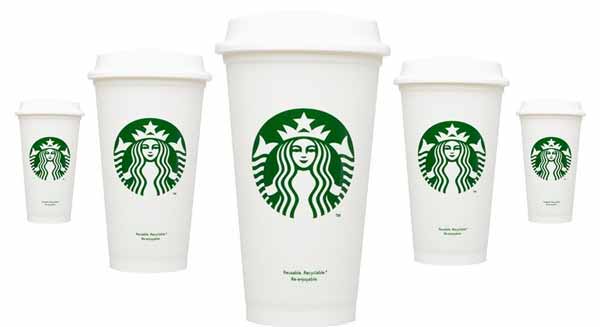
Starbucks Reusable Plastic Cups are an alternative to paper cups (Image: gizmodo.com)
I love Starbucks. It’s my go-to spot for late-night study sessions. (The baristas know me by name, #embarrassing.) Last week I spied Starbucks new reusable plastic cups that sell for $1. I had a mini internal physiological earthquake as I approached the counter. For years, I have eagerly awaited this moment!
Now some of you are probably thinking I’m a complete weirdo for being so obsessive about Starbucks offering a reusable plastic coffee cup (you do have a point). But these aren’t just more paper and wax Starbucks disposable cups. This cup is meant to revolutionize the way companies and society think about ‘to-go’ beverage containers. But do these Starbucks reusable plastic cups represent a true green marketing revolution — or are they just a green marketing ploy?
Introducing Starbucks Reusable Plastic Cups
For the past few years, Starbucks has hosted an annual “Cup Summit” that brings together the top dogs in materials engineering and packaging with Starbucks’ executives to strategize how to reduce disposable paper cup waste. The latest product from this gathering is their new reusable plastic cup, a look-a-like to their paper ones made from a ‘recyclable’ plastic. As an incentive to bring it in for a refill, (the Starbucks baristas will wash it out with boiling water for you), customers receive ten-cents off their drink.
Sounds pretty cool to me. Starbucks has created an incentive for coffee lovers to reduce the amount of material wasted by creating reusable cups, and making them more affordable than the $7 stainless steel coffee cups they sell in their stores and on-line.
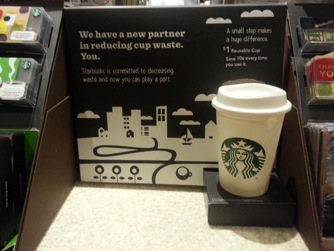
Starbucks reusable plastic cup display encourages coffee drinkers to reduce cup waste.
More Questions than Starbucks is Answering
Time to give Starbucks a pat on the back for their green marketing and green design efforts? Should we applaud Starbucks for these reusable plastic cups and thank them for being a leader in sustainability? (Enter science nerd side of me stage left). Not so fast!….I’ve got more questions than Starbucks’ website seems to be answering.
What about all the energy needed to create these reusable plastic cups? Are we just wasting more energy to create these rather than continue to sip from the single-use disposable paper cups? (How many paper cups does one need to avoid before offsetting the impacts of the plastic?)
Chances are, Starbucks regulars like me are going to wash these reusable plastic cups in the dishwasher (top shelf). This will require a lot of energy, soap and hot water (ditto for washing in the sink). How does this compare to the environmental impacts of a disposable paper cup?
As emblazoned on the cups, they are recyclable* with an asterisk — noting that they are not actually recyclable in all areas. So chances are they will wind up in landfills where they’ll likely sit for 500 years. Will Starbucks take them back for recycling? I didn’t see any signage or recycling bins to that effect.
I’ve heard these Starbucks reusable plastic cups are produced in China, so I’m wondering if they are traveling further than the throwaway paper cups – producing more greenhouse gases in the process.
To date, despite checking their website, asking the Starbucks baristas, and perusing other reports, I have not been able to find answers to my questions. Until I do, I’m sticking with my stainless steel coffee cup for my caffeine boost fill-ups (and I still get the ten-cents off).
What do you think – does this Starbucks reusable and recyclable plastic cup really help to cut down on waste or not? Is it good green marketing — or simply greenwash? Or perhaps somewhere in-between?
Related Posts via Categories



Miranda,
It’s always useful to question the status quo and alternatives, but I don’t view it as an either/or thing. Each cup type may provide an option to a different “segment” of users. No cup type offers a total “solution” and there will never be “0” impact of anything. (“Zero” landfill ?-please…) Kudos to SB for even raising and trying to deal with the issue-think of all the other places that aren’t-Dunkin, Baskin Robbins, etc…small stores, etc…
I’m with you-bring your own, if you can (may not be possible for a public commute into a City for an all day mtg).
SB in-store is too expensive as a regular habit. We buy bags of SB and make it @ home. Then, using the offer printed on the bag, take the bag in for a free cup (reduces cost of bag). They are supposed to recycle the bags (I asked SB corp. after I saw the bags disposed into trash-not sure how they’d recycled them…)
Starbucks even “offers” its coffee grounds for landscaping, which I’ve used a few times. Wonder how much of that material is disposed. Waste Management and other firms offer separate pickup of organics that could divert that material from disposal-it would be interesting to learn where SB uses that option (or what % of the total # stores).
Hi Ben,
Thank you for your comment! I completely agree that Starbucks at least is trying to promote more sustainable behaviors and has branded themselves as a eco-friendly company. However, I think it is still unclear whether this new cup is a step in the right direction or simply a marketing tool.
I recently discover collapsable mugs for traveling, which are an absolute life-saver when you need something light and doesn’t take up much space. They are pretty affordable (~$10), durable, BPA free, and made from food grade silicone (check them out at http://compare.ebay.com/like/370700841373?var=lv<yp=AllFixedPriceItemTypes&var=sbar). Perfect for the commuter!
I was thrilled when I learned about the coffee grounds offers, because my parents have a pretty extensive garden that my mom relies on to supply her restaurant – very cool initiative. Waste Management is involved with a number of cool projects (the organics pickup service being one of them), including methane capturing technologies.
Again thanks for the comment!
Miranda,
Nice post. I hope Starbucks, in their zeal to do something right by the planet didn’t wind up disappointing one of their ‘deep green’ own like you!
I couldn’t find anything about the cups on their website either, which is strange.
I suspect, after having seen the cups, their are made from a nice clean and durable plastic called polycarbonate — which I remember from my research years ago was used by dairies for refillable milk jugs — and the jugs could be used up to 60 times before they were recycled.
In this instance, without Starbucks taking them back themselves for recycling (given that local facilities are very limited — if exist at all), I fear that the cups — kind of like the ‘keepsake’ cups you get at Disney and the ballparks will simply wind up in landfills. This is likely compounded by the fact that they are cheap, too – just a buck.
I wonder if the real ‘answer’ to Starbucks cup problem is to simply charge extra for the paper cups — after the revolution ended (maybe they could try it here in NYC under the guidance of Mayor Bloomberg :), we may see a whole lot more folks toting stainless washable cups like you!
Hi Jacquie,
So I think that it might be made out of polypropylene, based upon this Starbucks blog article (http://blogs.starbucks.com/blogs/customer/archive/2012/10/02/save-money-cups-and-the-planet.aspx). Like Mark Eisen below stated, the recycling rate for these are pretty low (http://www.epa.gov/osw/conserve/materials/plastics.htm).
I agree – charging would be a great way to raise awareness and incentivize the behavior change. However, convincing Starbucks to make this “radical” gesture will probably be difficult…. But I am all for it!
Thanks,
Miranda
It took quite a bit of digging, but an editorial in Plastics News said the plastic material is polypropylene, or “PP”. It’s recycling number is 5 (“SPI” code, found in the chasing-your-tail triangle symbol). Why didn’t Starbucks simply disclose this? EPA reports that plastics recycling rates are overall about 7 or 8%, with most of that average being brought up by polyethylene (PE) recycling, numbers 1 and 2, where the recycling rates are only in the 30% range. Think HDPE (high density) milk jugs and LDPE (low density) plastic bags. So, the PP recycling rate is likely nil. Not to say it isn’t happening or even increasing, but it can’t be much now. I don’t think this is such a great move by Starbucks. Once this fact is known, combine it with another made in China export-a-job product, and no proof of concept, so to speak, in any known life cycle analysis. The hot water alone to rinse each cup at Starbucks will also add up. After all, a Starbucks is not like a car wash. As far as I know, Starbucks is not recycling their dishwater like a car wash recycles virtually all of its water. So this one size fits all strategy, for drought areas in particular or perennially starved water areas, has problems. Another thing I read is that in a few years Starbucks will be able to recycle their paper cups, having only recently cracked the code for being able to separate the necessary traditional inner liner material from the paper, which has been the holdup here. Apparently, efforts to recycle paper cups in their stores up to now have been problematic, but that is the goal. This makes the “reusable” PP cup an interim step. Starbucks should have just said so. Although PP is relatively durable, the reusable cups will have an average life of who knows how many uses before they enter the waste/recycling stream, and no one really knows in what time period or at what rate either alternative will occur. Or what profit Starbucks is making on each cup. Finally, I think Starbucks missed an opportunity to introduce a recyclable biobased alternative. They could have switched their paper cup lining to PLA, a biobased material, and used biobased material for their lids. There are plenty of opportunities to certify biobased, most prominently through USDA. Don’t roast their environmental people for this effort, however; I’m sure they are well intentioned. They were probably overruled by bean counters.
Mark,
Thanks for clarifying the kind of plastic as polypropelene (PP or #5). That, too is a very clean kind of plastic and is highly recyclable. It is also very light. That’s the reason why Stonyfield cites on their website for preferring it over #2 plastic for yogurt cups.
http://www.stonyfield.com/healthy-planet/our-practices-farm-table/sustainable-packaging
Stonyfield also talks about a in-store “Gimme 5” collection effort for wide-mouth containers such as yogurt cups made from PP (which are not collected in curbside programs.) Would be nice to think Stonyfield is considering a similar effort for these containers.
Hi Mark,
Thanks for the comments. I hope I did not sound like I was roasting the people behind the initiative – that was the furthest thing from my intention. Instead, I merely wanted to raise some questions I had about this new cup.
I think you are right about it being made out of PP (http://blogs.starbucks.com/blogs/customer/archive/2012/10/02/save-money-cups-and-the-planet.aspx). It is unfortunate that the company did not release a statement about their overall plans and that it did not at least explain why biobased products were not used. Maybe the next Starbucks Cup Summit with provide more depth into why it chose not further explore these technologies. Perhaps the company is merely protecting itself from more people probing questions.
No, when I looked for stories about the cup, I found a lot of media were criticizing them, thus my tongue in cheek comment was general. I did find it disconcerting that literally every news media merely reprinted the press release or criticized or complimented the company without so much as asking Starbucks some basic questions, like what type of plastic they were using. Is everyone still hung up on The Graduate movie’s “plastics” line? I also think that no corporation is doing this and suffering any financial advantage. Starbucks is no dummy. The $1.00 they charge is obviously way more than the cup costs them. They may have calculated how many times they thought the cup would be used, how much cost that would save them in paper and what the $0.10 refill discount costs them. Hopefully, they took all their costs into consideration and priced the reusable cup at their breakeven. It would be nice if Starbucks told us this, because the perception of a polypropylene cup stacked on mega container ships from China at a landed cost of $0.10 each and selling for $1.00 is not good.
Completely agree about the media – I could find no substantive information just product release updates in the media. Do you think there is anyway we can get Starbucks to issue a release at this point?
I doubt they would issue a correction or retraction; for Starbucks, they could update the information as part of a progress report, particularly if they get a favorable response. At this point, I think a national reporter would have to do a follow-up story about the effort. Not every thing a corporation does works, so at least SB could say they’re trying, learning and offering alternatives. There is a Greek island with very long living people, and today there was a report one factor could be the anti-oxident properties of coffee: http://www.nytimes.com/2013/03/26/science/on-one-greek-island-a-caffeinated-secret-to-long-life.html If I were Starbucks, I would concentrate some marketing on that!
I would put this initiative firmly in the ‘green demonstration’ category. With all the life cycle questions, it simply profiles the issue of cup waste without really being a very meaningful part of the solution. This sort of profiling can be moderately useful in spreading awareness to a mainstream audience who probably still doesn’t use a blue box, but I think Starbucks could have done much better. A corporation with their depth of resources should be able to pioneer the manufacture of cups from recycled plastic (see Aladdin’s ‘Sustain’ recycled plastic mugs here http://www.aladdin-pmi.com/collections/sustain ) or, as another reader suggested, move to a better lifecycle with their disposable cups. #RecycleFail
definite recycle fail. It just seems like this type of initiative is just 5 years too late. Considering they have invested in a CSR report and other environmental initiatives such as the CAFE standards (that have considerable available information), it is odd that they did not publicize this more in an effort to gain more attention as a sustainable brand. How do you think we can get them to do better?
Hi Miranda-
Like you, I have a soft spot for Starbucks and it is a go to space, it is the “third space” after all.
I agree with Ben Larkey, that no cup type offers a total solution. Many people are inconvenienced by stainless steel mugs and travel mugs because it can be difficult to carry, sometimes they leak or they don’t fit into a purse and sometimes people just forget to carry them all the time. I have yet to check out this new cup but it does look very lightweight, which would be a huge plus! Let’s look beyond the packaging and look at the actual content.
Drinking coffee in general isn’t the most environmentally friendly option. Caffeine doesn’t stay in human bodies it travels through sewage treatment plants then high levels of caffeine end up in waterways and oceans which can impact marine life.
Even though coffees and teas have been a cultural center for ions, another idea to explore is that are we adding to much caffeine to our coffee?
Hey Melissa,
Could you send me the sources about the caffeine affecting marine life? I haven’t heard of that before and couldn’t find any studies related to the topic. Also, as I mentioned to Ben, the collapsable silicone cup is awesome for those who are commuting/traveling/hate clutter/etc.
Thanks for you comment!
Hi Miranda-
I found these two studies:
http://pubs.acs.org/doi/abs/10.1021/es802617f
http://jgp.rupress.org/content/29/2/63.abstract
I’ll email you if I find anything else! 🙂
definite recycle fail. It just seems like this type of initiative is just 5 years too late. Considering they have invested in a CSR report and other environmental initiatives such as the CAFE standards (that have considerable available information), it is odd that they did not publicize this more in an effort to gain more attention as a sustainable brand. How do you think we can get them to do better?
sorry for the duplicate response to above – what I meant to say was THANK YOU! Very interesting research tied caffeine effects.
I was getting ready to post a response and thankfully took the time to read all of the other quite “cerebral” comments. So I will simply keep it simple by stating the obvious in this never ending debate about so many, many things in the myriad of sustainability discussions. Ready? It’s complicated…
Definitely complicated, without a straightforward answer. What do you think the next step for consumers and/or Starbucks should be?
Miranda,
Mark’s comments are very useful/informative.
Re: your point: “it is still unclear whether this new cup is a step in the right direction or simply a marketing tool.” you may be using rhetorical flourish, but it may not an either/or situation (I’d make that point about almost anything in life…)
If a co. has an improvement/solution, don’t they need to “market” it, or how would they communicate it to customers ?
I view it as a good thing that firms are integrating CSR into products/services for competitive advantage, even if there’s improvement potential. We don’t have to get it through the corp. gauntlet with competing priorities of cost/benefits.
Also, this is not a new approach. When I started @ Canon USA in 1999 as Sr Mgr Corp Env & Product Safety, the Sodexo cafe @ the NY HQ had this in effect, although I had to ask, because they had no information in the cafe (!) -I created/had them post a sign to rev up the program. It also was in effect at Sharp in 2011 (and they provide a branded free plastic drink container with lid to new employees-good marketing tool) with 1 cafe sign (would be better with more). Maybe food services have it in effect all over and SB has adapted it-whatever helps reduce waste.
Maybe SB could incentivize (?) more with “use it 5 times, get a free coffee” or similar, but that gets into cost/benefit ratio options and how to manage/track.
Hi Ben,
I am not arguing that marketing is not important – I think it is absolutely critical for both companies and improving environmental problems. Incorporating CSR into company operations is one of the most essential societal changes needed to address almost any environmental issue. But I am still not clear whether Starbucks’ cups and claims about its superior environmental impact is accurate. Do we actually know this cup and its actual use by consumers is improving the environment? How are they tracking use? How are materials for the cups extracted? How long do they take to break down? Are we building new facilities to produce these cups? The list goes on and on…
These questions have to be answered before we can determine whether this cup is better than the single-use paper alternative. False advertising/”green washing” is unfortunately a very real tactic used to market to consumers so that they “feel” the company is doing the right thing. I just would like to see the facts to back it up.
I rarely make my way to Starbucks, however understanding the influence Starbucks has over other industry players, I also had high hopes about this initiative. The outcome is a disappointment, and here’s why:
1. A narrow roll-out strategy: The fact that Starbucks rolled out the #5 plastic polypropylene cup but does not collect it for recycling (at least in NYC) demonstrates their lack of commitment to a solution of true impact. Since most people can not recycle #5 plastics in their town, it will likely end up in a landfill…and still be there 500 years from now.
2. Poor communication/education: Even with in-store displays and information on their website, it takes some digging to discover what material composes the cup. Baristas seem to also be uneducated and therefore can not energize consumers about it. Starbucks could have used the cup’s roll-out as a way to engage consumers. Instead, it wasted the opportunity and may have even taken a hit with environmentalists.
3. Unsubstantiated claims: They say the cup is better for the environment than alternatives but it is unclear how. I found no scientific information available (e.g. a lifecycle analysis) proving what they claim. Contrast this with the high degree of transparency Stonyfield displays in their choices of container and it becomes more apparent that Starbucks may be greenwashing.
4. Poor incentive: I have seen it multiple times in the “My Starbucks Idea” website and in other places that most customers will not change their behavior for 10 cents. Other coffee shops give 25 cents or even 50 cents off for bringing your own cup, so Starbucks’ incentive seems meager. It also shows lack of creativity since monetary incentives are not the only way to engage and motivate consumers. Why not give the greenest Starbucks customers special access (first taste of new blends, entrance into an special online community, special discount periods, etc.) as a better incentive?
As a company, either you put a stake in the ground by making your values clear and make the tough decisions that come with it, or you skirt the issue by making small, incremental changes and work hard to create the *image* that you stand by your values. Starbucks, please don’t be the latter!
Hi Rachana,
Thanks for your comments. The tail end of point #4 – ” Why not give the greenest Starbucks customers special access (first taste of new blends, entrance into an special online community, special discount periods, etc.) as a better incentive ” is genius. Why haven’t they done this? This seems so easy and taps into a very effective tool – gamification! If you can make something competitive, people are more likely to change behavior. I think we should pitch this idea to Starbucks – In?
Hi Miranda,
I am most definitely in! Let’s have an offline chat. Maybe Gabe can help!
Thanks,
Rachana
I also rarely make my way to Starbucks, but having finally tested the new cup this weekend I have a few concerns purely with the consumer experience, product life cycle aside.
To me, it seems a bit contrary to develop a new cup that is essentially still a disposable cup, provides a fairly insignificant discount to the consumer, and fails to provide many of the benefits that travel mug producers have worked years to perfect. While some travel mugs certainly leak and are a bit bulky to carry, there are now excellent options that I have found to be absolutely spill proof, such as the Contigo line of travel mugs. Contigo seems to be behind in producing recyclable mugs, but functionally they have been a great solution for me. At this point, I would be hesitant to put my empty Starbucks cup in my purse after finishing my coffee: it is bound to drip.
Part of the attraction of travel mugs is also the fact that they keep your coffee hot for longer. When given the option, I always opt to drink my coffee from a reusable cup in the coffee shop if I am going to drink my coffee quickly; otherwise, I always fill my travel mug to make sure that my coffee is still hot when I get where I am going.
As Rachana also mentioned, the consumer discount for using these cups is insignificant. Starbucks coffee is expensive and a 10 cent discount will rarely sway my opinion when making a one-item purchase. When I look for savings in my daily purchases, I usually opt for supporting local businesses that offer loyalty card programs with a reward of a free coffee after 10 purchases, or something along those lines.
While these concerns may seem trivial, at least for me, they are the initial impressions that will determine whether or not I use the new Starbucks cup.
Hi Robyn,
Starbucks main concern (as a public company) is to maximize shareholder value, aka make sure customers and happy and returning to purchase their product. So this viewpoint is absolutely critical for understanding the longevity of this product. Even if this cup had zero impact, if customers hate it, nothing is improving.
Miranda,
You may have thought of this, but as an aspiring CSR professional, you may create value for yourself / build your brand by communicating with Starbucks and informing them of this discussion, although since they’ve convened “cup” planning meetings, may have heard this all before.
Hi Ben,
I did think about this – any suggestions about how to go about that?
Hi Miranda!
I had a very similar reaction to you when I first saw that lovely little cardboard display touting a brand new usable Starbucks cup and lo’! It was only $1! I immediately looked around to see if there was one of these fantastic innovations that I could grab but there were none in sight. Not a great sign. “This ought to be accesible,” I thought. I asked the barista if I could purchase one the cups and it took her two minutes to find where they had been stored… another bad sign. Were these not being demanded by most customers? It was only a $1 guys, come on! I was still too excited about this new consumer choice to really have my spirits dampened. I posted a picture of my new cup on Instagram, linking it to twitter and thanking #Starbucks. I was happy to see friends respond positively, maybe they would by a reusable cup as well! However, as kept going back to get my trademark Earl Grey latte, I found that the “one-size-fits-all” cup, was not fitting my needs. I have a low tolerance for caffeine so a tall black tea is plenty for me, but because the cup is sized as a grande, I was being told by the baristas that I had to pay for the larger size. Mind you, the 10 cent discount did not cover the difference and I had no remind, and even challenge a barista at one point, that I even got a discount. The result was, I ended up wasting about a fourth of my drink every time and have become less religious about keeping my cup in my backpack.
I was also very disappointed to rarely notice anyone else on campus with a reusable Starbucks cup, relying instead on the familiar paper container. I was frustrated that college age kids were not making a cheap and sustainable choice, but I noticed that only two times, out of the many, that I went into my Starbucks, the display was up. What I once had believed to be a fantastic environmental initiative, I was now considering rather skeptically. I began to wonder if this plastic cup was going to be recycled or if it would end up in a landfill like so many other plastic containers; and was the plastic type was even recyclable? It seems to me like Starbucks has taken a potentially great sustainable initiative and quit half-way to the finish line. Starbucks should be advertising more for their new cup and training their employees better to understand this product. Customers should also not be forced to purchase a size they don’t want.
This new cup could be the star of a new sustainable initiative and advertising campaign for Starbucks; they could be making the cups in country to reduce on travel costs and carbon emissions, they could be advertising a recycling program like with their coffee bags, “Bring in your old plastic cup and we’ll recycle it for you and give you a free cup of coffee!” Baristas could be trained to ask customers if they would like to purchase the reusable cup. But none of this has happened and the Starbucks website offers very little information about their new cup. These demand and supply-side problems were clearly not considered and with everything else I have read from your post and the comments, this cup is far from a solution to the waste generated by the international queen of caffeine. Maybe I had been too quick to thank Starbucks.
Hi Dana,
I have the same issue happening on my campus. Except where I live, the baristas regularly tell me these cups are “hot” items yet I have not seen ONE purchased or carried. The lack of educational material for customers, employees, or the inquisitive mind highlights some sort of problem with this product’s release (at least to me ?). The fact that your friends liked it on instagram but may not actually buy the product is interesting – have you asked them about the discrepancy?
Hi Miranda,
My friends who liked the post don’t go to my university so I didn’t get the chance to find out if they had bought the new cup. Also most of my friends on campus choose other coffee vendors, like Saxby’s, 7/11 or Dunkin Donuts, for their caffeine fix because it’s less expensive. I didn’t mention it in my post but I also noticed that the Starbucks in Center City Philly didn’t have the new cup display up either. Like you said, the lack of educational material is clearly a problem with the success and impact of the Starbucks reusable cup.
Hi Miranda,
My friends who liked the post don’t go to my university so I didn’t get the chance to find out if they had bought the new cup. Also most of my friends on campus choose other coffee vendors, like Saxby’s, 7/11 or Dunkin Donuts, for their caffeine fix because it’s less expensive. I didn’t mention it in my post but I also noticed that the Starbucks in Center City Philly didn’t have the new cup display up either. The lack of educational material is clearly a problem with the success and impact of the Starbucks reusable cup.
I personally am a very big Starbucks fan and I have to say I love the new cups. I actually had a Starbucks sticker and put it on a blank plastic mug, until I saw this. This was exactly what I wanted from Starbucks, and I’m “helping the environment”. In all honesty these plastic cups probably aren’t helping the environment any more than just the paper cups. However, I don’t think they hurt the environment much more either. It’s probably just a marketing technique. Starbucks will get customers to come back because of their small discount they get from re-using their $1, the cups probably don’t cost much more to make, and Starbucks gets credit for “going green”. Needless to say I do fully support Starbucks and the effort they show, even if it doesn’t help much.
Official environmental comparison response here if you’re interested!
Firstly, thanks for the wonderful blog write-up!
Secondly, please allow me to introduce myself: I represent the company that developed this cup for Starbucks. I’m the Director of Innovation for a major food/beverage container company that’s been around for many years.
First things first, this cup was not an output of the Starbucks Cup Summit, although I wish it was somehow more closely tied to their initiative! It is really a solution we developed and pitched to Starbucks, as they already buy many of the “$7+ stainless” reusable containers that you referenced…
The cup represents the very beginning of a truly big idea: closing the loop on one of the most useful plastics–PP. It is the safest plastic for human use (food contact) and is the most “recyclable” plastic in terms of limited “down-grading” as it is cycled again and again. It’s really a wonder material that simply isn’t used enough (and as your readers accurately stated isn’t returned/reclaimed enough). We’re all working on bettering that.
In the meanwhile, it is still a better alternative that a single-use disposable paper cup. We ran LCAs (life cycle analyses) on this new PP plastic cup to directly compare it with Starbucks paper cups. These studies have been performed with reputable firms and with data supplied directly from Starbucks. Without sharing too much information (as Starbucks plans to eventually do a proper press release). Our new plastic cup is Carbon Footprint “breakeven” (or equivalently environmentally damaging) if you use it about 4 or 5 times. Now if you use it just once and throw it in the trash, it is nearly 3x worse… but that just isn’t the intention. It’s a reusable cup. After 10 uses, the carbon footprint is nearly half that of a paper cup (or technically 10 paper cups). These calculations consider all factors you correctly pointed out: manufacturing energy to form the cup, transit from China and trucks to the stores, even the hot water rinse and dishwasher cycles. Everything has been considered in it’s “cradle-to-cradle” life.
We are most proud of introducing something at the price-point that has never before been occupied by a quality, reusable cup. We believe that be getting more consumers to try reusable cups (by lowering as many barriers to adoption as possible), that we can begin to induce behavior change toward solutions that are more environmentally responsible.
Despite Starbucks’ future with the cup, we intend to push the limits of technology, design, marketing, and business relationships to repeatedly deliver solutions intended to change the world through encouraging more responsible consumer behavior. We want to reduce waste, promote sustainable systems, decrease carbon footprint, and ultimately help everyone to see material as precious–something we should use over and over again!
Thanks again for your positive view and support of this initiative. We hope to deliver new product soon that hits your radar again with major retailers of the world. Together we can change the world.
Hi Gabe,
Thank you so much for your response and joining the conversation. Like others have commented, I am thrilled your company and Starbucks have used LCA to assess this cup’s environmental impact since its the only true way to answer many of the questions I posed. From your post, it seems critical for customers to use the cup at least 5 times before tossing it into the trash. So I have a couple more questions:
Why isn’t there more education/communication to the public about this?
Is there anyway to monitor repeat usage using Starbucks current system as of now?
Is there going to be any marketing that educates the consumer about the value of #5 plastic?
Also, when are they planning to release the press release you mentioned?
Is there a plan to eventually phase out the use of these cups to promote using more durable tumblers?
Again, thank you so much for your comments and helping me and others understand this cup’s role in solving wasteful behaviors.
Gabe,
Thank you for this post- it certainly helped clear some things up! I am very excited to hear that your company performed a LCA on the product, which gives more substance to Starbuck’s initiative. The information you found out through the assessment is interesting and should somehow find its way to the greater public! Even though I am still not %100 sold on the pure sustainability of these new cups, I must say, it is a step in the right direction. Nothing will completely change over night, but there must be the beginning steps! This cup shows that SB (a major industrial and cultural icon) is at least starting to get serious about sustainability-which will hopefully only further fuel other companies to do so. In order to “break even” so to say, one must use this cup 4-5 times, which, although seems difficult to account for, I don’t think is an unrealistic vision as the cups are less bulky than original stainless steel mugs. And although that would be ideal, for each customer to have the most sustainable option, that is unrealistic. If a customer pays and uses this cup even 2-3 times, they are still diverting that many cups from ending up in the garbage. Overall, it seems like a step in the right direction, though I would like to see more transparency from SB regarding this product.
Thanks, Gabe. That’s great news and a great story. Starbucks has a great opportunity to tell that story. I would recommend they take your summary and print it on every paper cup.
Gabe
Great to see you did an LCA on the cups! Its refreshing to see some thought analysis going into a decision making process. However, I’m not convinced that people will use their cups 4-5 times. I have a sneaking suspicion that if people were going to reuse their cups, they would just buy the metal mug. If your assumptions are correct, and people will reuse at least a few times, then it is a step in the right direction. It will be interesting to see how it pans out. I wonder how the low recycling rate of PP will factor in and if there is any way to quantify the average number of uses per cup?
Cheers
Ryan
I’m with Ryan. This cup is neither here nor there, and sounds like a terrible idea! Why would someone pay an extra dollar for a cup that is difficult to recycle when you could invest in a travel mug for 5-10$ that you could have for years? Or better yet-wash out a FREE mason jar leftover from something in the fridge and ask them to fill it with your beverage of choice. I know, I know- “but glass gets hotter than this amazing new plastic cup!” I haven’t looked outside yet today, but it’s likely still freakishly blizzarding, and chances are you’re wearing gloves, so break out the mason jar!
Bringing your own mug/jar/cup, shall we say a “vessel” for liquid gold coffee, is obviously the most sustainable option. No matter what you choose, you still have to remember to bring the damn thing when you go to get coffee! Luckily, the generous 10-cent discount applies to ANY cup you bring-not just this barely-recyclable one.
Isn’t PP a #5 plastic? Is Starbucks going to pay for Action Carting to carry away all the additional plastic waste generated by the sale of this cup-or put strain on recycling plants when people toss them in with the normal recyclables? The “cup” idea is definitely a work in progress…best of luck, Gabe.
I think what I like about this new cup is that it meets needs that are not met by the heavier (and usually thicker) stainless steel or ceramic reusable mugs. I commute primarily by Metro/bus/walking, so I truly value a reusable cup with that has virtually no weight and is slim enough to fit in my work messenger-type bag. Being so lightweight, I can keep the cup in my bag every day even if I don’t want coffee, just because it’s so minimally intrusive.
Of course, if there was a heat-friendly cup that collapses or folds flat, that would be even better! But this new cup mostly meets my needs. My wife has one as well, so we have a couple of these cups that rotate through dishwashing at our house. Since I’ve started using the cup(s), I’ve had about 4 fillups (2 hot drinks and 2 cold drinks, I believe).
I live in LA, where the city’s recycling program has been taking #5 PP plastic for years, so recycling is fairly easy, though as is the case with many recycling programs, I’m sure most city residents don’t know what is and isn’t recyclable.
Many of the Starbucks employees do NOT know about these cups! I travel the New Jersey Turnpike frequently, and have had 3 instances where employees fill my recyclable cup but don’t know how to ring up the purchase with the discount. Many of them also don’t know how the top of the cup attaches to the bottom of the cup – in two instances, I had to snap the top on myself because they could not do it. In the NJ Turnpike Starbucks outlets, there is no signage indicating that they offer these cups. As another experiment, I asked to purchase one of the cups, and the person taking my order didn’t know that Starbucks offered cups like this!!
So: Starbucks, you need to TRAIN all of your staff (not just your managers) about the cups!
Perhaps Starbucks’s messaging is to blame, but my understanding is they’ve launched these cups as a bridge between their customers who bring a more durable reusable cup and those who normally use paper.
Despite their efforts SB hasn’t been able to reduce single-use paper cups much. Perhaps customers do not develop the habit of carrying their cup with them; perhaps they don’t see the benefit of paying $10-20 for a reusable cup. For the users who want to use a reusable cup, this new cup gives them a relatively low barrier ($1). Perhaps people will accumulate a few of these, wash them (and washing a cup is almost always better from an LCA perspective then a new cup, but it depends on how wastefully you wash), and then have one on their desk, one in a briefcase, one in the car, and one at home, so they’re more likely to have one at hand. At this price point, it only takes 10 refills for this cup to pay off.
It certainly would make a lot more sense for SB to gather PP for recycling, but remember, the point of this is to not dispose of it at the store, you should take it home, wash, and reuse it until it’s worn out, then recycle it.
Pingback: Hitting the Starbucks Chord: A Bloggers Dream | Mrs. Green's World » Mrs. Green's World
But Rich…what are folks supposed to do with them after they’ve reused them, let’s say, the max number of times? It would only benefit Starbucks if they provided in-store recycling. They’d keep the no longer usable cups out of landfills (because no one really has access to #5 recycling), they’d have an opportunity, presumably to sell another $1 cup to the same consumers — and they’d look like heroes all the while.
Yes, Jacquie, I agree that Starbucks should provide in-store recycling of their plastic cups for that time that you’re done with it and remember to bring it back. They could even give a discount on a replacement! That would increase the likelihood that cups would get recycled after multiple uses and not trashed at home.
I guess what I should have said is
“It certainly would make a lot more sense for SB to gather PP for recycling, but remember, the point of this is to not dispose of it at the store, you should take it home, wash, and reuse it until it’s worn out, then recycle it [either at home or at Starbucks].”
If anyone wants to recycle #5 plastics, it looks like you can take them to drop-off sites on Preserve’s Gimme 5 list. Lots of Whole Foods locations — including the ones in Manhattan — are on the list.
Here is the list:
http://www.preserveproducts.com/recycling/gimme5locations.html
I’m very glad that I now have a local site to drop off my yogurt containers. Hope this helps someone else, too!
Hi Miranda,
When I think of buying a new reusable cup at Starbucks, I immediately share your worry that it is, indeed, new! I too wonder if all the energy that will go into creating and transporting the SB branded cup will fail to offset the energy used and waste generated by the original cups. I see here that the cup does save energy, after 5 uses. My fear is that if there is no financial incentive to remember the cup that users will forget it more often than not.
I’m currently living in Copenhagen, Denmark. Here at the grocery store, we have to pay extra to buy plastic bags. It’s not a huge fee, but it’s enough to make me remember my backpack and a re-usable tote when rushing to re-fill my fridge. Perhaps this is another solution? Charge for the paper cups and hope the price spike is enough to make chronic coffee drinkers remember a travel mug or purchase the new renewable cup – and remember it.
Cradle-to-cradle wise, what happens to this cup when the avid coffee drinkers stops using it when they want to give up their caffeine addiction? Does the cup get passed on to a friend of family member or does it just end up in a landfill? Should Starbucks be responsible for taking the cup back and reselling it? Otherwise, what we have is another flimsy plastic-produced cup. To me, it seems like a wiser investment to stick with your own single travel mug that could withstand being thrown around in a purse or suitcase. Plus with a steel mug, if you give up coffee, it can always be used for some hot soup in the winter!
I’m not sure there’s a groundswell of folks giving up coffee anytime soon, but supposing there was, couldn’t those folks just use the cups for non-caffeinated beverages? Someone who reuses this cup for coffee might not be so quick to just throw it away just because they gave up caffeine.
Jacquie, at the risk of knowing more than I should for the few times I go during a year, the local (W. Caldwell, NJ) store has a recycling container that I think includes plastics, and does not exclude #5. SB could state on the signs that they accept the cup in the store for recycling, or it can be recycled @ Whole Foods.
Ben, this idea is great. imagine if all of the Starbucks on major highways had recycling containers for these cups. Frequent travelers would not be tempted to put them in the usual large refuse containers (at least i hope they would not be tempted!).
When I first read this post, I was immediately reminded of a similar situation in which marketing efforts didn’t quite accurately reflect the ‘green’ nature of the product.
Marketed as 100% recyclable plastic packaging made up of up to 30% plant products, Coca-Cola/Dasani’s PlantBottles have been extremely popular with consumers. I’ll even admit that I was initially impressed by these claims.
However, a recent project prompted my to investigate these claims further; are these bottles as eco-friendly as marketed? In conversations with the director of a local recycling center, as well as environmental scientists, I’ve found that this is not the case.
What Coca-Cola fails to point out is that these bottles contain bioplastics that melt at lower temperatures than other counterparts. This causes major issues when the bottles are sent through the traditional recycling stream. Not only do they clog up machinery, but also contaminate the recycling stream. Given this information, does it even make sense for consumers to be recycling these bottles?
This begs the question, were Coca-Cola’s eco-friendly efforts worth it? Does it make more sense to revert to the previous bottle model that required more resources for production, but could safely and effectively be recycled?
I’m forced to consider what other eco-friendly efforts/products might not be as friendly as they’re marketed to be. It seems that in this situation, as well as the Starbucks example above, innovators failed to think beyond the immediate production and obvious use of the products. At what point do companies like these cross the line from plain ignorance to taking advantage of the general unawareness of society?
Jen,
I think you rightly point out that not all bioplastics are as recyclable (or compostable) as consumers seem to believe.
However, I’m wondering if you might be confusing Coke’s “plant bottle” made with 30% biobased PET with water bottles made from PLA (polylactic acid — often made from corn.) The latter looks like PET water bottles and are not recyclable. (They are in fact compostable in industrial composting facilities.)
From my direct experience speaking with Coke executives about the Plant Bottle, — and based upon claims made on their bottles, which need to go through strict legal and technical clearance, I understand that those bottles are definitely recyclable within a regular PET waste stream.
It’s all pretty confusing: Some bioplastics are recyclable but not compostable; some are vice versa; and some plastics made from petroleum are actually degradable, while not all bioplastics will degrade – yikes!
Reusable cups are fine but not for us TEA drinkers. The taste of tea is primarily a function of aroma and plastic retains aroma, so tea never tastes good in a plastic cup of any kind. So to make a resuable mug that’s successful, people have to like it, and without even trying this I can say the tea would taste terrible. So back to disposable paper – or – my own ceramic mug that I bring from home in the car (and which spills all the time!).
Also stainless steel mugs are a good alternative!
Hi Miranda
perhaps people should take their own mugs to starbucks? Anyone who did could have a discount on their coffee?
Stephanie, Starbucks already does offer a $0.10 discount for using your own mug OR to anyone who asks for a “for here” cup (it comes in Starbucks own ceramic mugs).
In my opinion, it all comes down to this: Unless it actually costs a big company money to run an eco-friendly project, in my book it is called green-washing, that is, a promotional project like any other, where they invest with the objective to get a greater return. The only qualifying exception would be to clean up after a PR disaster where a company’s brand equity is clearly at risk, in which case they can’t afford to look at the price tag because the potential loss is bigger. Realistically, being green is trendy and is currently being used as a tactic among others in most big companies’ marketing plans. They try it and if the ROI is better than it is with other tactics, then they keep at it as long as it does not damage their brand equity in any way. The good thing with being green is that it’s more or less seen as positive by everyone, whether one actually walks the green walk or not. It is an added, make-customer-feel-good plus. Even more so in the case of a wasteful company like SB.
I rarely go to SB and always to meet someone, not because I want to. I believe that if you really care about the environment, and don’t forget your health, for that matter, there are a lot of things you can do before buying this reusable cup:
– Kick the SB habit/addiction and make your own coffee. Some reusable stainless steel insulated Thermos bottles (come in various sizes) perfectly keep beverages hot for hours. And we’re not talking about cooking from scratch here, just turning on the coffee machine in the morning. Buying one will pay back in no time.
– If this is too radical, then, bring your own glass/ceramic container. It is the absolute best for hot drinks, health-wise, with plastic #5 being the least worst plastic option, based on current scientific knowledge. But it is still not meant to be reused, which is the only way in the SB case, it can break-even from a pollution impact perspective. You also do not want to use plastic containers for hot beverages. They boil-wash it for you? No thank you! Heat (via them, or from a dishwasher), just like scratching while washing or using, are all big no nos with even the safest plastics, because it leads to toxic chemicals leaching into your drinks. And as stated above, #5 is not commonly recyclable, and unfortunately, Preserve’s Gimme 5 program is not known as it would deserve to be. Even if it was, what would realistically be the proportion of consumers actually bringing their #5 plastic to participating Whole Foods Market stores to recycle it in the Preserve bins? (Preserve makes toothbrushes and razors (sold among others at WFM) out of it so a least it is a virtuous cycle since we endlessly need/use these items.) So chances are these cups will end up in the trash, then the landfills, and that, is the cradle-to-cradle scenario analysis we should want to see.
In my last visits to SB I did see the $1 plastic cup display on the counter and found it genius marketing to actually make customers pay $1 for this feel-good-I-am-being-green feeling all while being paid to save money on the paper cups they save themselves from selling the plastic ones instead. As it has been mentioned above, chances are, if you cannot adopt the habit to bring your own (free, safer for your health if made of SS or glass, and least polluting option), you will forget to bring back this plastic one as well. My second thought was to check out the type of plastic used (which was missing!!), and while #5 is for sure better than a #3 or #7, like many others I don’t understand why the rationale was not extended all the way through to bringing a Preserve bin in store, for all the good, logical reasons Jacquie mentioned. It would have been free goodwill directly injected into their brand. They obviously did not do their homework or fully thought through this initiative, just like the lack of appropriate corresponding and full POS communication and online information shows. It seems that only the ROI calculation part has been fully completed, and likely was the only base (along with the expected brand benefit of a green initiative from a consumer perception perspective) for green-lighting (:-) this project.
The Dasani plant based bottle also mentioned is a great analog and another example of bold green-washing, just because it takes guts to suggest that one of the least eco-friendly products existing (a plastic bottle of water!) could be somewhat green. Even more in this brand instance since Dasani is purified water, a.k.a. filtered tap water! The green cap, the 100% recyclable (uh yes, like any other #1 plastic!), the copyright on “plant based bottle”, all unconscious make-feel-good well thought marketing tools make me believe that the bigger the marketing message is, the most chances it has to work.
I think Starbuck, just like most other big CPG companies saw an opportunity in jumping on the green band wagon as a different yet-to-be-tried marketing idea. They did not invest much time on a well thought through plan and cradle-to-cradle analysis on the true expected lifecycle of these plastic cups with their own customers, all the while making sure they would, not break-even, but actually make money off of it. In the end, a smarter (business-wise) than green project.
Had they replaced their disposable paper cups with compostable/biodegradable cups (truly green but more expensive option) and put in place a full path from local production (not China) to making sure all used cups, along with their coffee grounds end up biodegraded in the soil of local farmers free of charge to them, that would have been a different story. The #5 reusable plastic cup is just an example showing how the Howard Schultz Starbucks of the beginning has evolved into a typical corporate entity like any other.
Well said, with new information and thinking. I think SB needs to do a life cycle study on their business itself, if that’s possible. They may find most of the company’s environmental impact is not from packaging (meaning their cups), but packaging seems to the easiest target and most tangible symbol of waste and thus greening to consumers, and sometimes the easiest for the retailer to tweak. We’ve reached a point possibly where retailers are proactively competing for a green image in the most visible way possible when it is difficult to do with products themselves, else their competitor will do so and appear to be greener. Its a lot easier for a home center retailer to appear to be green by selling an l.e.d. light bulb than for SB to do it with product.
A good article, but I was puzzled by one thing: If we’re generally in agreement that the lowest impact method of getting takeout coffee is to use our own mugs, then why did the article raise the concern about the energy, soap, and water expended in washing Starbucks’ reusable cup? Wouldn’t we be using the same resources to clean a ceramic or steel mug? If so, then this variable is a wash (no pun intended) when comparing the Sbux plastic cup to existing reusable mugs.
I agree with you and don’t quite have the answer either. I will make one comment. If these cups end up in a landfill, we actually have no idea how long they will be there. Possibly much longer than 500 years. We don’t really have information about how long plastics take to decompose in landfill environments because plastics have not been around long enough for any of it to decompose. SCARY!
I was in Starbucks this week in Atlanta and they do not have the cups. Either still in testing, or a slow rollout, adopted on an ad hoc basis by regions, districts or individual stores, or based on volume or merchandise mix, or a flop?
I haven’t seen them around so much here in NYC – and when I have they are getting “bottom shelf” type treatment – and employees don’t really even seem to talk about them.
Hate to say it, but despite the trying, I think the concept is basically flawed.
I think they would have more immediate success frankly, promoting reusable sleeves. I keep one in my purse – so easy to do.
Paloma, you and the other readers may be interested to know that both Whole Foods and Preserve confirmed in replies to my inquiries that the program accepts ANY and ALL #5 plastics, even if it’s not on the list.
For example, many of the plastic plant pots and multi-plant black plastic trays are #5 (some are #6 or unlabeled). That begs the question why big box retailers selling plants that have other recycling programs sucha s for CFLs, plastic bags, etc,,, like Home Depot, Lowes, etc… don’t have Preserve bins set up with customer education efforts to divert the packaging from products they’re selling from disposal to resuse.
FYI, it turns out that tennis ball container tops (black plastic) are #5 (the clear plastic containers are #1 and aluminum tops are of course both recyclable)-ever see recycling containers at or near tennis courts-not at our local high school, in NJ, where recycling is “mandatory”. In addition, some plastic tubes of consumer products (toothpaste, foot cream) and the twist off tops (ones I checked are labeled enough to recycle) are or may be recyclable but the lack of complete symbols or messaging on the tube, packaging and co. websites are not optimizing packaging returns (without citing brands/products that we use that I’ve been investigating). Seems like alot of improvement potential for product packaing and messaging.
Ben, thanks for replying to my comment. You’ve collected some great info. I’m excited that Preserve can recycle/upcycle all #5 plastics. I think a lot about how to systematize my recycling efforts to make them both easier for me to sustain and also easier to encourage others to adopt. Now I’m happy I finally have a solution for some plastic plant pots and tennis ball container tops.
I agree with you that there is a lot of room for improvement but I am glad that we are having this conversation. At least we are slowly finding some answers which we can then share with others.
Also, I just found some exciting news. It looks like as of April 2013, New Yorkers can finally recycle “rigid plastics” including #5 plastic:
http://www.nyc.gov/html/nycwasteless/html/resources/plastics_nycrecycles.shtml
http://www.nyc.gov/html/nycwasteless/downloads/pdf/materials/Checklist-8.5×11-web.pdf
I’m excited to tell my friends that they can finally recycle their black plastic clear-lidded take-out containers!
This comment will focus on how Starbucks can motivate their consumers using financial instruments/policy.
This debate is analogous to that of eco-friendly totes verses the standard conventional plastic t-shirt bags. You can find a good article about the pros and cons of totes here http://online.wsj.com/article/SB122238422541876879.html – a Wall Street Journal article titled “An Inconvenient Bag.”
From my own personal experience, these cups aren’t durable enough to last more than what is estimated at fifty uses. The price of the cup (1 dollar) is trivial, and users consequently treat it as what it really is: disposable. Two years ago I purchased a 30 dollar SIGG thermos that has never leaked, keeps liquids hot or cold up to day, and features a screw off top that seconds as a cup. The fact that I payed more money for it makes me value it more. I don’t view it as disposable but rather use it everyday.
While Starbucks’ efforts certainly have flaws, I absolutely applaud them for trying. I think it’s interesting to think about how you can motivate people to be more sustainable in their coffee drinking ways. In other words, how do you incentivize consumer behavior around drinking coffee. I think what’s most effective about Starbucks’ policy, is that you receive 10 cents off on your drink when you bring in the reusable cup. There is financial incentive to save the cup and reduce waste. Similarly, at Wesleyan University’s late night coffee shop, the cups cost 25 cents to use. According to the management, this was not to increase profits (college all nighters seem to guarantee profitability) but to motivate students to bring in their own mugs and containers. Similarly, Skidmore adopted what I’ll call a mobile mug program where students can use a mug at one location when presenting their “mug badge” and simply drop it off in one of the “mug bins” positioned around campus, where they are washed and restocked. If Starbucks really wanted to motivate their customers, a similar policy could easily be implemented: Cups cost 25 to 50 cents and/or high quality reusable travel mugs can be borrowed when an SB customer buys in on what is essentially a mug-rental program.
The alternative is government intervention, and while it seems extreme, there are a number of towns (Westport, CT) and even cities (you guessed it, San Francisco) that have already banned plastic t-shirt bags. If a fraction of the coffee industry’s lobbying capital went to an effort to ban paper cups, change would be significant and immediate. Consumers would have the option of downing the coffee in-store with a mug, or taking it away in their own reusable mug. Until then, I think the SB has the right idea with their 10 cent off policy, but I think they can do more to motivate their customers using financial incentives.
Good post… ty for writing it.
I have for the last 3 weeks been spending a lot of time trying to find out Starbucks commitment to taking responsibility for their carbon footprint. I simply do not understand any reason for them NOT doing a BETTER JOB! I saw a figure of $13.5 BILLION dollars in sales last year. They are listed about NUMBER 5 on top FORTUNE 25 COMPANIES. They have a huge problem and seem quite behind what they could be offering in ways of NOT creating so much waste and carbon.
I was given a 1 lb bag of Pikes Roast coffee and when I tried to find recycling info on the bag there was NONE. I asked at two different locations and spoke with staff and TWO managers. Clueless. They did not know what to do with the bag.
I cut the bag open… it has a pretty big chunk of plastic in the front of the bag and it serves some kind of VENTING. There is plastic, foil and wire on the bag… ridiculous. SO I called Starbucks Headquarters Customer Service number and the girl I spoke to was clueless. Did not know what to do with it and when I asked her why they don’t take it back and THEY can be responsible for their garbage instead of me and she gave me a ditto response as to why some stores have recycling bins and others don’t.
So it is clear that they have a CORPORATE response that is memorized and nothing MORE. After posting on their Facebook page and asking questions and feeling like I was attacked by sheep who can’t THINK and then twice sending email. I seem to finally awaken someone who explained to me that the Pikes Roast bag that I referred to can NOT be recycled but the REASON they choose this bag is because the carbon footprint that it would take to provide me with the freshest coffee is MUCH GREATER! Truck transportation…etc. YUP… Brilliant!
I EXPECT MORE AND I DEMAND MORE…. they need to do more. MY LOCAL STORES DO PROVIDE ME WITH RECYCLING BINS>>>> MY LOCAL STORES DO PROVIDE ME WITH PAPER ECO FRIENDLY HOT USEAGE CUPS. They have made the investment for recycling and for eco cups. Why can’t Starbucks. Forget it. They are pathetic and they don’t care. They are greedy and their “GREEN” stance is bogus in comparison. They also gave me a number to call so we could “talk”. I will call them next week. Here is the number… give them a call – please! Ask for BETTER CUPS. They told me to call this number to discuss it further. 800-782-7282
First, I have to say I never write with capital letters because electronic etiquette considers it to be screaming.
Second, I wouldn’t be too hard on Starbucks. They have been and continue to be an environmental leader. When I founded Home Depot’s environmental marketing department in 1990, Starbucks was one of the first and few companies out front. Their website is really clear about what they have done and continue to try to do. And there is a section where you can submit environmental and other ideas to them.
I’m sure each new generation of environmental marketers, those now 40 years younger than me, tries earnestly to tackle the recycling challenge. Just like real estate markets are local, the recycling infrastructures continue to be this way and remains a challenge. I faced this at Home Depot where we literally dumped out our trash compactors to try and recycle the contents. Starbucks is facing the same challenges today, as is every municipality.
In terms of the coffee bags, compostable bags have only this year come onto the market. Here’s the information link: http://www.packworld.com/sustainability/renewable-resources/compostable-coffee-bags-make-north-american-debut. A little googling can go a long way towards finding information that can be used to help encourage Starbucks to adopt this next generation packaging rather than to assume they don’t know what they are doing or are irresponsible.
Once it is roasted, coffee oxidizes very, very quickly and starts tasting bitter. Mass marketers who are faced with having coffee go through distribution must package it for freshness. They vacuum pack it or as the writer noticed, can package it with a valve that lets the carbon dioxide escape and minimize the oxidation. The oxidation is worse for ground coffee vs. beans since more surface area is exposed to air. This is why so many of us grind our beans at home.
No doubt, part of the equation is perception, which is a necessary part of marketing. Coffee sold unpackaged that sits out is not the way to go, so the perception it is fresh is enhanced by packaging it in a competitive manner, that is by the bag itself promoting freshness. At today’s prices, I’m not so sure even consumers who are the most ardent recyclers would rather have a bag that they can recycle if the result is the coffee goes bad too quickly. I think they’d opt for a little landfilling until a better alternative comes around, which hopefully it has. Regardless of all of this, if you are a true coffee lover, you buy your beans green and roast them yourself. In addition to buying the best beans and brewer, it is the only way to truly assure your cup is as fresh and good tasting as possible.
AmyL: I sympathize with your frustration. I return the empty bags for my free cup of coffee and was told when I asked corp. that they were recycled and to tell them which store was not recycling them. Despite seeing my local store folks throw them into the trash, I ignored my inner advocate, elected to reduce my agita and “let it be”(not ask the local staff about it)-that’s SB job to do it right.
The stores also have ALOT (sorry for the caps Mark, but it is a GREAT way to emphasize a point) of coffee grounds that are available but get disposed as trash, despite firms like WM that offer separate (but not cheap) organics collection service. I kind of like the recycling bins @ SB, but do folks know that even the sugar packets/straw wrappers can be recycled in the “paper” bin ?; or that the wooden stirrers could be included with the coffee grounds for organics composting ? SB. Like the rest of consumer services/ products/ packaging has alot of potential. Interesting: SB routinely overfills cups (even my refillable that I ask for 2inches of room for milk & get a 1/2 inch if I’m lucky) and I’ve seen many customers pour the “overfill” into the trash. Even if SB doesn’t pay their trash vendor by weight, that’s unneeded weight in the trucks, if nothing else. They could provide a employees could empty when they refill milk etc…
I don’t go often (only for my free cup) and usually buy ground coffee on sale & make my own at home, so it’s just how I like it/cheaper.
Hope you’re all enjoying this amazingly beautiful day (NYC area).
As an avid Starbucks drinker I remember when they first introduced the reusable plastic cups. At the time I was in college and could not resist buying a $1 dollar reusable coffee mug. Around the same time my school’s student government started their own reusable mug campaign. Regretfully, it was short-lived. In general it seems that while people are thinking green and trying to make changes, these plans are often rushed and tend to overlook some of the larger questions.
For example, the coffee mugs given out in my school’s dining hall were large, bulky plastic mugs, that were certainly not recyclable. In addition, the student government didn’t think through the fact they were giving 18-22 year olds reusable mugs and expecting them to return them daily to the dining hall. Instead the majority of the mugs began collecting in places such as laundry rooms and bathrooms of the dorms. As a result, many got broken or thrown away by the custodial staff. So about a month into the new reusable coffee mug plan, most of the mugs were gone. At that point, these mugs, like the reusable Starbucks mugs, most likely ended up in a landfill.
From a purely environmental view these campaigns certainly seem as if they may be doing more harm than not. Yet, as an eternal optimist, I can’t help but hope that they are doing something good. While the physical impact of reusable mugs may be worse than their disposable counterparts, the effectively send a message. By implementing such campaigns people who aren’t strict environmentalist and don’t have a background are forced to acknowledge the impact of their own waste. For this reason I believe that the Starbucks mugs are green marketing. They encourage people to examine their lifestyles and reassess the decisions they make from a green point of view.
Sara,
You raise a great issue, a paradox really. College students are quite idealistic about the environment. So how come we can’t get them to return the reusables to the cafeteria — any ideas?
‘Junky’ Jacquie O
It would be good to know a bit more about the dining hall setup at this college. When I was in college the dining hall used durable cups and mugs that were not meant to be removed from the premises (no to-go cups). Students could choose to bring their own reusable mugs if they wanted to take their drink to go. It put the onus on the student and kept the unnecessary waste to a minimum.
I would argue that students should not be expected to cart a drinking vessel to and from their dining halls (why not utensils, etc.?). Instead–though I thought this was already standard dining hall practice–dining halls should be using only durable drinkware and not disposables.
That said, I can see how students would need a reusable mug for the visits to the campus coffeehouse or convenience store. In this case, I would probably focus my efforts on getting campus retailers to either charge for disposable cups, or offer a well-publicized discount for patrons bringing their own mugs.
As I mentioned in an earlier comment, I think the dimensions of the reusable mug are key. Typical travel mugs are somewhat bulky if one is already lugging along many other items, like books and other class materials. It may sound funny, but maybe the time is right for an insulated coffee flask! 🙂
Alika,
Love your idea about charging for disposables. Given though that college students are such big coffee drinkers, ideally they should all use their own refillable coffee cup in the cafeteria as well as local cafes, etc. Love the idea of a flask! I suspect there’s a new product idea in their!
Thanks for chiming in here, too. (I believe it’s your first comment on this blog? If so, welcome!)
-‘Junky’ Jacquie O
Actually, I’ve commented on this article a couple times in the past, though looking back, it appears I used my full name at the time (Ailka is faster, though a Facebook or Google integration would be convenient).
I’m still going to have to disagree with you on expecting college students to bring their mugs to their dining halls. Because most(?) dining halls already use durable cups/mugs with fairly efficient dishwashing systems, it seems to me bringing one’s own mug might be a wash (so to speak). In the well-caffeinated late ’90s, most fellow students I observed opted for soft drinks, iced tea, and lemonade during meal times. Coffee might be consumed at the end of the meal, but dining hall coffee was *far* less popular than a la carte coffee purchases from a coffee bar (possibly due to the lower quality of coffee offered in a cafeteria setting).
But in an a la carte beverage purchase, I’m certainly with you that it makes sense for anyone (not really just college students) to bring a reusable cup/mug. One challenge I have seen when I’ve done this is that counter staff frequently are puzzled trying to figure out how many ounces a given cup holds and how much to charge me. As it comes in a standard size, the Sbux refillable cup does make things a bit easier for their baristas in that regard.
Just wanted to chime in here and say this still is one of the top 3 blogs in my journey as Mrs. Green. Love seeing the continuing conversations and love Junky Jacquie O.
Make my day, Gina, why don’t you! Love you back! “Junky J”.
Hi Everyone,
I have really enjoyed what I have read on this thread so far and wanted to address the reusable mug on campus campaign that Sara K. mentioned… I went to a small school that ran its own cup campaign that was successful and remains popular among the students. I think its success was largely due to the way it was run. Mugs were left on trays when they were dropped off at the tray return in the dining hall and by the next meal your mug was waiting for you clean and dry right next to the tray drop-off. Students would enjoy the ability to carry out their mugs full of coffee in the morning and return them to get cleaned at lunch time. This method seemed to work because there was no discrimination on the type of mug that was dropped off (meaning Nalgenes and sports bottles also were given the green light). The campus’ café also promoted the use of reusable mugs by agreeing to fill all sized mugs as well as holding special discounts to those that came in with their own mug. I think the lack of rules is what makes the schools cup campaign successful
In related news, I came across this interesting article about the town of Brookline in Massachusetts. Brookline recently passed a ban on polystyrene (Styrofoam) cups and plastic bags effective in December leaving many establishments begin to think about alternative materials. The five Dunkin’ Donuts located in Brookline however have decided to get a head start on finding the best alternative to Styrofoam cups. In this article and news clip it is clear that Dunkin’ Donuts has yet to find a solution but at least these locations are taking the first steps in a greener direction…
http://www.necn.com/08/20/13/What-are-you-drinkin–in-cardboard/landing_business.html?blockID=850119&feedID=11126
Maybe the answer is that the car companies should not just equip vehicles with cup holders, but a reusable cup system.
I’m with you, Mark. But let’s not limit to the car companies. How about all companies. What would it take to make it ‘natural’ to bring a cup with your wherever you go?
Great article and even better commentary. If Starbucks was really committed to the triple bottom line and sustainability, they’d come up in a member search on #BCorporation.net. The only way Green Marketing finds success is when messaging and behaviours are transparent to the marketplace. Clearly, the inordinate amount of investigation required to determine which plastic resin was used to manufacture the cup belies a transparent experience for both the consumer and Srarbucks’ own front line team members.
I am not convinced that maxing out the life of that cup offsets the transportation costs not to mention the “unseen costs” of manufacturing from virgin PP resin chip.
For communities employing single stream recycling (everything into a single bin), it is safe to include #5 PP waste. It’s sorted at the MuRF (Municipal Recycling Facility). Once sorted and cleaned, those materials your MuRF location does not have a large enough market for are typically ganged and held for aggregation with the same material(s) from other MuRFs in their network.
On a side note – and VERY late in the conversation – Coca Cola/Dasani indeed uses PET and initially started running in the US at 10MM# of recycled chip in 2007 with target for 100MM# by 2009. I have toured the facility in South Carolina where this initiative launched as they were my client at that time.
My wish is there were more people interested in Green even 1/2 as much as we are. The vast majority of people are not interested at all and unless those consumers receive a meaningful benefit or a harsh punishment, their behaviour will not change.
I have also always been skeptical about Starbuck’s in terms of how eco-friendly the company actually is compared to the image it portrays. That being said, the other day I was pleasantly surprised to see that Starbucks now has a recycling bin right next to the pick-up station as well as the exit. This is definitely a step, as many of their products come in packaging that can definitely be recycled. The promise this has to improve waste management is incredible, yet the problem is that while some of their products can be recycled (ex: cheese plate), the cups are still not recyclable in the US due to a lack of demand for the material of which they are produced. If Starbucks were to find a way to change the composition of their cups and recycle them in the store; they have the opportunity to reduce 2.3 billion paper cups per year in the landfill, according to Business Insider. Starbucks made a goal in 2012 to develop comprehensive recycling solutions for their paper and plastic cups. On their website, it says they are “on track”, so lets hope that they come up with it soon.
Dunkin’ Donuts now has a reusable cup similar to Starbucks, made from the same resin code 5 (PP – polypropylene). It has “reduce, reuse, recycle” imprinted on the side and “cup must be clean before refilling”, but doesn’t say whether the store will wash it. It has lenticular graphics, which are expensive. Lenticular graphics animate, like the little pens you tilt with the girl in the bikini on them. On the bottom is the website of the cupmaker, capitolcups.com, which has a very nice eco section on its website.
Pingback: Starbucks new reusable plastic coffee cup: greenwashing or green marketing? La Vie En Green
While I try to stay away from entering a Starbucks or purchasing their products, because I’d rather support local coffee shops, I do think this is a step in the right direction. Like many coffee shops now, Starbucks provides an incentive to bring your own cup by providing a discount on your drink purchase. They also sell the reusable cup at a low cost unlike other reusable mugs, which is another incentive to purchase it. But I think their design is flawed since it looks like another paper cup and doesn’t really advertise the fact that when one drinks from it in public they are using a reusable mug to drink their coffee.
I think its important to start shifting the culture of take out food and coffee shops to inecentivize customers to bring their own reusable tupperware, utensils or mugs. This can be one of the most effective ways we can limit waste. As more people bring their own reusable gear businesses, will no longer need to provide disposable items. I think there are good efforts to start getting consumers in line with this behavior. Just Salads for example sells a $1 bowl that customers can reuse to for discounted salad purchases. Also there are a number of coffee shops in Portland, OR that will sell customers coffee for $1 if they bring their own cup. I think these incentives as spread across the board will help drive consumers to be more waste conscious.
What’s the difference between what Starbicks is doing and every grocery store out there selling reusable bags?
Pingback: Cup Addiction | RightNowRaw
Just thought I would share this recent article from TreeHugger which compares two other options for reusable coffee cups. One – the Cortica – is made from the all natural materials porcelain & cork. The other – the Smash Cup – is collapsible so its easy to keep in your bag and is made from food grade silicone.
Check them out on TreeHugger here
Maybe these are even better options than Starbucks’ own cup. What do you guys think?
I love this post because it’s pretty timeless — 17 months later and this is still a relevant issue! In looking back at the original question of “green marketing or greenwash”, I’d really like to think that the $1 reusable cup was an honest attempt by Starbucks to reduce waste from disposable cups. However, is this the type of incentive that is supposed to trigger a tipping point in consumer behavior?
I’ve talked to more than a few people who purchased the $1 cup, and the issue remains that they need to remember to bring it back. Which, when you think about it, is the problem in the first place. It’s not like we don’t ALL own a reusable cup somewhere in our kitchen cabinets. It is this “convenience factor” that I think is most important in encouraging environmental behavior change, and I’m not sure the $1 cup accomplishes anything in this area.
Starbucks recently published their “reusable rate” for 2013 — the percentage of drinks that got served in reusable cups. (Starbucks has a 2015 target of serving 5% of all drinks in reusable cups.) In 2011 and 2012, the rate was static at 1.5%, so I was really interested in seeing what kind of uptick would occur as a result of the $1 cup. The result? The 2013 rate was only 1.8%.
There is obviously still plenty of room for improvement on the “cup problem”, and I’m glad to know there are so many passionate people willing to discuss a solution!
This was a very interesting and well thought out post. I am not a Starbucks ‘regular’ but I do go to Starbucks every month or so. At first, I did believe that the reusable plastic cup was definitely a smarter idea and seemed like a fair price, but once I read through the other questions that were posed, I am now unsure of how ‘sustainable’ the Starbuck’s green cup may actually be. I find it odd that Starbucks is unresponsive to relevant questions and it seems that they are actually ‘greenwashing’ rather than actually being more supportive of the environment. I think it would be helpful if specific quantifiable metrics were produced to all the questions that were posed and to evaluate from that perspective rather than simply guess. I think this is a very important issue to address and one that should be discussed internationally.
Hi all,
With disposable coffee cups still being such a relevant issue, we have just launched our latest post on Drew Beal’s ‘Kill The Cup’ campaign. College students are encouraged to take selfies using reusable coffee cups to help reduce disposable cup waste! We encourage you all to have a read: http://www.wehatetowaste.com/college-reusable-coffee-cup/
I know that Starbucks abroad often serve coffee in normal ceramic mugs for to-stay/eat-in customers. Couldn’t they do this in America?
When asking whether using reusable cups over paper cups cuts down waste, it’s important to consider a life cycle analysis of each. The inputs that go into making one single use paper cup are probably much lower than those of the reusable cup. So, if one were to only use the reusable cup a few times, the paper cup is definitely the winning contender in terms of lower environmental impact. However, if a consumer commits to their reusable cup, it is very plausible that the high number of uses results in an overall lower impact on the environment. I feel as though it might be worth it, as I assume that if a consumer is going to buy a reusable Starbucks cup, they likely buy Starbucks coffee on a regular basis. A similar debate is also had when determining whether to choose paper or plastic bags. Overall Miranda, you’re probably better off with your stainless steel coffee cup! Interesting article!
I don’t know…. the paper-making process is so chemical and effluent heavy that anything that avoids making and transporting paper sounds like a better deal environmentally.
Pingback: Does the Starbucks Reusable Plastic Cup Actually Reduce Waste?
Pingback: Does the Starbucks Reusable Plastic Cup Actually Reduce Waste? | Toronto Sustainability Speaker Series (TSSS)
These cups have morphed into the next trend. See Etsy and search for Personalized Starbucks Cups or go to CleverHollyDesigns.com for a direct etsy link. I do know that these cups, especially once personalized, are reused over and over for a long time so they have a longer life cycle. I hope I’m not breaking any posting rules as I do have an affiliation with the web link above.
Pingback: Up date so far – Months 4 to 6 | searchforthesimplethings
Such a great conversation. That you for teeing it up and sharing your story. And although few of us are ready to turn away from industrialized coffee (vs buying bulk bean, using multipurpose grinder, and steeping in French Press at home/office), it does force us to realize the impact of “us”. High impact. Low impact. Water footprint. Carbon footprint.
That said, my families journey just added 4 16oz “Thermos” mugs to be used for our trips to Starbucks (and for other uses). My daughter (inspired Environmentalist) is running the numbers to see if our impact is reduced or increased considering production, lifespan, and recycling impact. As a degreed scientists/biologist whom LOVED my physics classes and learning about the laws of Thermodynamics, I am not optimistic about the calculations. That said, the discussion will always get us closer to variables – and one of the variables is “us”.
Thanks again for your post and good luck and gratitude for your schooling and career choice.
I wish they shared more numbers, but this is the sort of geeky analysis I am looking for…
http://www.anthropocenemagazine.org/2017/07/reusable-or-disposable-which-coffee-cup-has-a-smaller-footprint/