



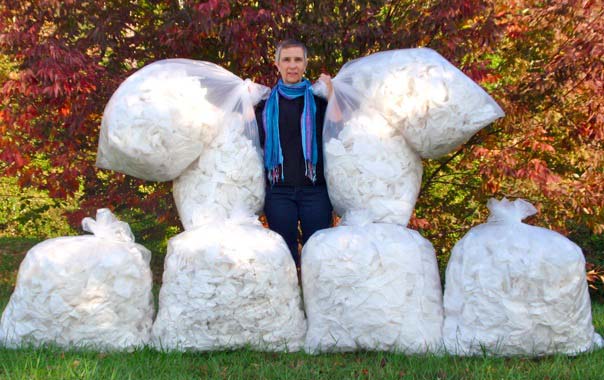
Mary Wallace of People Towels with paper towel waste. The average person uses 2,400 – 3,000 paper towels at work, in a given year (Image: People Towels)
On my first visit to Japan in 1998, I was given a gift of a reusable water bottle, a cloth bag, and a set of hand towels. My host informed me that these were all necessities for my stay. I really didn’t understand the whole “towel” thing until my first visit to a public restroom. There were no paper towels or hand dryers anywhere to be found.
I soon discovered that everyone in Japan — men, women, children — young and old carried a hand towel.
And because everyone carries them everyday, they can be purchased everywhere from the corner convenience store to major department stores like Mitsukoshi and Takashimaya. People even collect them from places they visit on holiday.
In fact, I compiled quite a collection after 8 years of traveling there. My collection came from Puroland (Hello Kitty’s home), Tokyo Disneyland, and famous shrines and museums that I visited. But my favorite one of all, I received as a Christmas gift from my grandkids – a lovely towel with snowflakes and Obasan (Grandma in Japanese) embroidered on it.
The Birth of “People Towels”
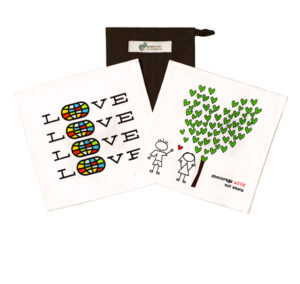
“For the Love of Earth” and “Love, not Waste” designs by People Towels (Image: People Towels)
I liked the concept of carrying a hand towel instead of using rough paper towels so much that I shared it with my business colleague, Linda Lannon. Together, fueled by our passion for the environment, we launched PeopleTowels, in 2009. We took our savings and placed a bet in a bad economy that Americans would adopt a new eco-habit and be willing to B.Y.O.Towel.
We knew it was going to be a challenge because the U.S. had become such a throw-away culture propelled by mass marketing and advertising. But we saw that segments of the population were beginning to carry other reusables like water bottles, shopping bags. So we thought, if 127 million Japanese can do this, why can’t we?
Respect for the Land
The Japanese never adopted the use of paper towels and other consumable paper products. I believe these are some of the reasons why: only 11% of their land is arable. They do not have the “luxury“ of wasting precious land to create landfills. Their culture is one of respect for their land and natural resources. Individuals are responsible for their own waste.
In Tokyo, a city of 13 million people, there are no trash cans on the street, yet you will find no litter along the sidewalks. If a person has waste to dispose of, they put it in their purse or pocket and take it home (where they pay a hefty price to dispose of it).
 Making the Switch to “People Towels”
Over the past three years, we have learned much about the American consumer. There is still a very small percentage (19%) of the population that is willing to spend more to purchase “green” products and be active stewards of the environment. We have also learned that old habits are hard to break. Nevertheless, given the desire and commitment to make a small change that can have a big impact, even the most diehard paper towel users can make the switch in about 3 weeks.
Are you ready to make the switch?
Related Posts via Categories


Hi Jacquie and All,
That is fascinating. And your information on Japan and how and why they came up with this way of doing things.
The “people towel” is a great idea. I take it the cloth bag is for carrying the used wet towel? I carry beach towels and bathing suits in the car all summer just in case a friend or sponsor, (when I do summer Parks and Rec programs) says would you like to take a swim in the pool…or lake….
Carrying a hand towel in the car isn’t much of a leap. I’m putting one in the car and performing equipment for the trip to my show tomorrow, etc. Took a while to remember I have the shopping bags in the car when going into stores, but now it is second nature. Let’s see how long it takes for this to become second nature!
Peace, Mike
PS… Hmmmm? Sooooo….since I’m a guy… and not carrying a purse….any suggestions on how I get this towel and the towel bag into store bathrooms, etc. without causing a stir.
Mike,
The eco-sack is for storing your PeopleTowel. Our customers share with us that in order to remember their PeopleTowels, they put them in very visible places – by the front door, in the console in the car, hanging on a push pin in their office cube, etc..
The towel never gets really wet, only damp after drying your hands. I recommend that you just carry the towel in your pocket. Once in the car or back at home/office, just pull out the towel and lay it out to dry. It only takes a short time before its dry and ready to reuse. If you carry a reusable water bottle, the towel can be clipped to the bottle using a carabiner hooked through the hang tag on the back of the PeopleTowel.
We have a lot of guys who use PeopleTowels so I’m hoping some of them will share their thoughts, as well.
Whoops… Mary. Didn’t see you bio right away. Great article! And ideas!
Peace, Mike
Been following People Towels on Twitter for some time now 🙂 Sure would be nice if the concept caught on in the US. Our “throw away culture” really is a disgrace!
Kudos to the Japanese for their waste efforts. However they get an “F” for Whaling a practice that really needs to stop!
Thanks for following PeopleTowels. What do you think it’s going to take for this concept to catch on? Some good news on Japanese whaling – younger generations are protesting.
http://www.digitaljournal.com/article/340003
10 years ago the practice of carrying a reusable water bottle was unique. It became wide spread through incentivizing. The industry saw that there was a substantial increase in the consumption of single serve water bottles and reusable bottles jumped on the trend as a cost-effective option. By the early 2000s, colleges, banks, retail stores and many other places began offering reusable bottles of their own for little to no cost.
The concept of reusable towels would pick up popularity if a similar strategy to bottles were offered; that is, at minimal cost to consumers. A possible option may be to team up with local merchants or schools and apply a logo or mascot as decoration.
Nathaniel,
Thanks for your comments and sharing your insights into the growth of the reusable bottle trend and how PeopleTowels could follow a similar adoption path. We believe that adopting the use of a personal hand towel is a whole lot easier than a reusable water bottle – it isn’t heavy, it doesn’t sweat and can easily be carried in your pocket!
Private label PeopleTowels is a growing segment of our business. A few of the organizations for which we have created towels are Stonyfield Farm Rewards, The Nature Conservancy and the Aquarium of the Bay.
Great suggestion regarding teaming up with local merchants and schools!
I have never heard of or thought of this concept. Easy for me to do…thanks!
Kate,
Thanks for your comment and glad to hear you think it will be easy for you to do! Can you share your ideas on how to easily adopt this new eco-habit?
Great article and product Mary. Your towels are perfect for travelers and the general public, not only do they prevent less waste but they allow each individual to have their own hand towel at all times. As you stated, most Americans are very much a “throw-away” culture but at the same time when it comes to nice things, people hold onto them. I do believe your product has a chance, a great chance, it just needs a push, perhaps some advertisement on a good morning show!
Your price point is great especially for an environmentally consciously made towel and there are so many wonderful design options. I would agree with Nathaniel that it might be easier to get a jumpstart on things if you got private labels to team up with you such as universities or websites.
Your product would definitely come in handy for all of those times when there was no paper towel left or you were at a friends house and did not want to use their hand towels or there were none. There are so many instances where bringing your own towel would be handy, those who have it ingrained that waste doesn’t matter may consider the fact that they would rather have their own towel in the first place.
Hi Karine,
I really appreciate your comments and your insight regarding the various uses for PeopleTowels, the price point and how we might jumpstart the widespread use and adoption of the B.Y.O.Towel eco-habit. We would love to be featured on any one of the morning or other talk shows. Any ideas on how to make that happen?
A friend of mine traveled through Japan many years ago. When she came back to the U.S., she was amazed at the large and fluffy towels I had at my house. She told me that during her year-long traveling through Japan, she used only a shammi (sp?) for drying off. It was small but absorbed the water from her body, and she could easily wring it out. It dried every night and was ready for the next day.
Tamara,
Very interesting story about your friend’s travel to Japan. Like PeopleTowels, most of the Japanese clothes, towels, etc. are light-weight and dry quickly. Many homes do not have clothes dryers. They just wash their clothes and hang them on a line/rack to dry. Some hotel chains and cruise lines are considering switching to towels made from a lighter weight fabric to reduce their carbon footprint and costs.
This is really interesting, Tamara, because I am sometimes annoyed at the weight and inefficiency of our oversized and bulky towels. They don’t have to be terry cloth. A thinner fabric is more absorbant and dries faster on the rack, plus it gets into the nooks and crannies better! I assume these Japanese hand towels are about the size of our oversized washcloths. They could be easily slipped into a sandwich baggie. Just think of all the uses they can be put to, where we use Kleenexes, paper towels, wipes, etc!
Hi Jocelyn,
Yes, PeopleTowels are 9″ X 9″. Folded in quarters, they easily fit into a baggie and have a number of uses including all those you listed.
Hi Mary & all,
Great post and wonderful idea. The most significant takeaway for me here is the central role of culture. I don’t know whether this is a good thing or bad thing. On the one hand, culture is often highly arbitrary, and can–and constantly does–change and evolve. On the other hand, culture can be so ingrained that we literally cannot see outside the norms of our daily routines, the Durkheimian “doxa” of our experiences.
In the end, I think it’s clear that even if the BYOT idea is currently cultural anathema in the US, there’s no reason it can’t be translated into our cultural idiom. Bringing your own reusable water bottle has become mainstream because it seized upon preexisting elements in our culture: everything from team pride (as Nathaniel mentioned) to conspicuous consumption as a marker of identity (as in having a gritty Nalgene covered in hiking stickers). A lot of the hope for translating the values to America, as with many waste issues, comes down to the fact that “waste not, want not” and good old thriftiness is still in our cultural DNA. I think the outlook is good for this idea–it’s got common sense on its side!
PS I have my own way of avoiding paper towels–air drying!
Hi Hayden,
Thanks so much for your comments. I agree, culture plays a big role in our daily routines and behaviors. Fortunately, as you say ” good old thriftiness is still in our cultural DNA” and we will make changes that make sense. Right now paper towels seem to be a mindless convenience – used for seconds and tossed away. What I continue to observe in my travels is that the majority of people think nothing of using hands full of paper towels in public restrooms for seconds and tossing them away. How can we help them make sense of using their own towel to reduce waste? Kudos to you for avoiding paper towels no matter how you do it!
Hi all,
This product is great and I hope it catches on. I can think of a few people that I would love to give PeopleTowels to as a gift. Besides the obvious environmental benefits, the best part is that PeopleTowels are lightweight. I personally always reach for the thinnest and most worn out towels when I need to dry off. They just work better!
Perhaps look into the superior cleanliness of PeopleTowels compared to the average restroom paper towel dispenser. People really hate germs and the prospect of getting sick (look at Airborne, it’s just vitamin C). And while reusable water bottles did save money for people who made the switch from disposables, paper towels are free. So maybe paper towel users will need that extra little incentive to switch over.
Hi Kellen,
Thanks for your insights. A recent blog post on our website https://www.peopletowels.com/ptblog/ focused on using PeopleTowels and good hand washing hygiene to avoid germs. With PeopleTowels, you’re the only one using your personal towel so you’re less likely to come into contact with the germs of others. Your towel, your germs, your hand hygiene routine.
What type of “little extra incentive” would you recommend to get people to make the switch?
Hi Mary,
I will admit my first reaction to seeing PeopleTowels was to think of the sanitation part of reusing a hand towel–but then I began to think of the concept of gym towels and how people willingly reuse the communal towels in their gyms and fitness center. While I’m sure those sorts of towels are bleached excessively I think there is something to be said about the culture surrounding gym towel use. Maybe a good incentive program would be to talk to local gyms and ask them to give free classes, or perhaps discounts on membership or even just beverages at their juice bar–for people who bring their own PeopleTowel. Just a thought, but this could be a good market place to first introduce the product to people who are likely to need a towel and then use that publicity to boost the message of PeopleTowel to encourage customer to integrate the use into their everyday lives. In my experience people who regularly go to gyms or fitness classes understand how important it is to live a healthy life, and with that grounding are more likely to be concerned with the health of the planet.
Hi Mary. Great thoughts! I have been doing this for years. I typically have to tell my friends to use my dish towels rather than my paper towels when they are in my home. Their response is typically “I know I shouldn’t use paper towels but it’s just so much easier!”
One potential way to change paper towel behavior might be a strategy I have seen at local gyms. The gyms have water bottle filling stations that count the number of plastic cups saved if you use your own water bottle. I have seen the number on these water fountains as high as 25,000! Seeing the impact that you are making definitely motivates you. Maybe there is a way to start a marketing campaign to show the number of trees saved if you use a towel instead of a paper towel?
Hi Chris,
Kudos to you for not using paper towels for years! Yes, paper towels are easier, but the environmental impact is staggering. Unfortunately, because our trash removal, especially in public places, is so efficient most people don’t see/realize the impact.
We do know that the average person uses approximately 3000 paper towels outside the home each year. I like your idea of creating some kind of counter that could be displayed near the paper towel dispensers to show the savings of using your own personal hand towel.
Thanks for this wonderful post. I have always felt bad about using disposable paper towels in public restrooms all these years and never thought about bringing my own towel! which is very easy thing to do.. I just washed my small sized hand towel that was just lying around so i can bring it with me wherever i go from now on. Thank you! Btw, when i lived in South Korea, I have also noticed that they never adapted the use of paper towels. Also their recycling/composting system is well practiced. I hope that someday US will ban paper towel use in public restrooms so we can reduce waste, toxins and save millions of trees
I found this article very interesting. I think it’s a great idea in carrying around your own towel to use. America is trying to be better though, by making everything automatic, from the toilet to the sink to the lights and to the automatic hand dryer. We’re getting there.
Hi Catherine,
I’m glad you found the blog interesting and like the idea of carrying your own towel. Yes, America is getting there on many fronts, but we still have a long ways to go when it comes to reducing our waste from paper towels. Each year, we Americans toss a staggering 13 billion pounds of paper towels into the landfills.
Hi Mary,
Thank you so much for sharing this post with all of us. I was excited to learn about Japan’s hand towels and PeopleTowels! I just checked out your website, http://www.peopletowels.com. The designs are great and I really like how people can create custom towels. I see that as a way to further promote the PeopleTowels brand.
For example, you could partner with a local school or kindergarten class where they teach the importance of hand washing and personal hygiene at a young age. The students would probably get a kick out of having their own towel with their school’s logo or mascot on it. Possibly even include a small note or tag with the customized PeopleTowel to ensure that the conversation about your product and sustainability continues once the students go home to their families. I also really like the idea that they can be clipped onto reusable water bottles as well because most people travel with their bottles.
I think cleanliness is also another way that you can market PeopleTowels as you have previously mentioned. Using your own personal PeopleTowel also greatly reduces the need (and $) for harsh instant hand sanitizers. However, I still think there needs to be a way to appeal to consumers who just want to use the hand dryers that most bathrooms today provide or simply air dry their hands.
Thank you for your comments. I do believe that working with children beginning at an early age to teach the importance of hand washing, personal hygiene and the environment is critical. It is key, not only to promoting the B.Y.O.Towel concept of PeopleTowels, but a cultural shift for taking personal responsibility for your health and the environment.
There is a research out there on hand sanitizers and hand dryers. Some studies show that they are not all that they are cut out to be.
http://www.abc.net.au/science/articles/2011/02/15/3139197.htm http://www.thedailygreen.com/living-green/blogs/organic-parenting/hand-sanitizer-66031401
I really love the concept of People Towels. As has been mentioned several times, American culture is that of waste and the throw-away mentality. Why, when I was a little girl, we had an iron from my dad’s youth that we still used. I bought a new iron when I went to college and it broke in six months. It’s actually cheaper to throw it away and buy new rather than fix it, and that is so disappointing. That mentality has spread like a virus into everything, packaging for goods, goods themselves, paper products, plastic bags, bottles, glass jars, clothing, furniture, etc.
I wrote a paper in college about the mentality of marring something “new” rather than accepting something used as just as good; I think it applies to the throw away mentality where the theme is the same; people have been conditioned that having new things on which they can put their own scuffs and dings gives them power and that adulterates the use of the product in the first place. It no longer is a paper towel to be used to dry ones hands, but rather a paper towel that is to be used and then THAT PERSON chooses its fate and throws it away. Like a new shirt from a department store that ONE MAN has the opportunity to wear, soil, stain, wash, and toss out or donate, he has the power to take something clean and new and damage it. But it’s still a perfectly good shirt! So, again the theme switches from using a shirt for warmth and cover to using a shirt solely to wear it in from new to used and discard it. Unfortunately, this wasteful mentality is literally burying us alive in garbage. The Japanese culture tends to have more respect for things, people, nature, and scarcity than Americans have had, based on history, though there are exceptions. Their culture’s respect of humanity and lack of dominating power over others is reflected in their use of hand towels. To them, a towel is a towel, to be used and reused, simply, to dry ones hands.
Tara,
I found your comment “…mentality of marring something “new” rather than accepting something used as just as good” very thought provoking. I’d love to read the entire paper. How do we encourage our fellow Americans to let go of the conspicuous consumption and adopt a lifestyle that is more respectful of possessions, people and nature?
Yes, we are literally burying ourselves in garbage, but those in charge of trash removal are so good at it that we seldom see the environmental consequences of our waste.
I can see how personal towels are a commonality in Japan and are more easily integrated into individual lives compared to the US. I can give a similar example of sustainable practice from South Korea- a country with a similar problem of insufficient arable land. On a recent visit to South Korea, I noticed that every household recycled and those that did not or overlooked a loose plastic bottle or two were scorned upon by neighbors and bystanders. The idea of not properly separating your trash was unthinkable! Every person actively participates in the sustainable practice and expects their neighbors to do the same, and neighbors participate because they feel pressure to follow the popularized practices of others. I think this mentality helps drive the use of personal hand towels in Japan but believe PeopleTowels should be a commonality everywhere. The approach to integrating and popularizing PeopleTowels in other countries will have to be strategically different.
Gina,
Yes, South Korea and other Asian countries have never adopted the paper towel habit. I recently met a gentleman from Thailand and shared the concept of PeopleTowels with him. He loved the concept and shared with me that he now lives in the U.S., but practices many of the customs of his native country such as using cloth shopping bags, handkerchiefs and cloth towels.
How do we get our fellow Americans who were raised in a “throw-away” culture to actively participate in the sustainable practices?
Ah! Several years ago a Japanese business associate gave me a lovely box with two fairly thin hand towels inside. Now I know the significance. Thank you!
Hi Katie,
Thanks for sharing your story. Yes, personal hand towels are often given as gifts in Japan because they are so useful and reusable.
I love this! I always hate going into public bathrooms and wasting paper towels – I almost never use them at home except to clean up really awful messes (such as those commonly made by my two senior dogs! ;). I don’t know why it never occurred to me to throw a small hand towel in my purse!
Hi Kelly,
Kudos to you for not using paper towels at home except for those messy clean-ups. It should be really easy for you to make the move to B.Y.O.Towel when you are on-the-go because you already have a sustainable mindset.
My kindergarten twins used this post as inspiration for their science fair project. They compared whether we use more paper napkins for our school lunches and snacks or for our home meals. We learned that we use the same, but we also realized how easy it was to change out the school napkins. So they have decided to use People Towels at school, and they will be presenting their findings at the science fair this coming weekend – with a People Towel (and an excerpt from your blog) on their poster.
Hi Kristen,
I was so excited to hear that my blog post about PeopleTowels was an inspiration for your twins’ science fair project. I would love to know more about their findings. It is small acts of individuals like your twins that have a big environmental impact. They are an inspiration to all! Good luck, to them, this weekend.
Pingback: How to Make Money by Helping Consumers Reduce Watts, Drops and Other Waste
Having just returned from a trip to Japan, I am also in love with the concept of the personal, portable hand towel, and am eager to try to spread the idea. Rather than purchasing trinkets and useless souvenirs for my friends and family, I stocked up on the seasonal hand towels – cherry blossoms, at the moment – and gave them out when I got back from my trip, along with a short explanation of what they are used for. So far, everyone has loved them. The towels are no bigger than a handkerchief and pretty to pull out of your purse or pocket in the bathroom.
PeopleTowels sounds like a great company to support if you are looking to give a gift in the united states. As some of the other readers have suggested, custom towels for schools or companies might be a great idea.
If you are just looking for a hand towel for yourself, though, and do not want to go out and buy something new, why not repurpose a bandana into a hand towel for your purse? Most people have them lying around somewhere, unused. Another possibility is to cut your old cloth napkins that are no longer suitable for the table down to a smaller, pocket-friendly size. If you hem the edges to keep the fabric together, you will have given new life to your old favorite patterned fabrics.
No matter where you decide to get a hand towel or what you decide to use, I think it’s a great idea to support and spread.
Hi Robyn,
I am glad that you had the opportunity to experience the use of hand towels in Japan and truly support the B.Y.O.Towel concept. Your suggestions are great in regard to reusing bandanas and napkins. Our goal is to reduce paper towel/napkin waste – however one can accomplish that whether it be from purchasing PeopleTowels or reusing something you already own.
I’ve got my new WHTW People Towel in my purse and have begun to use it, but am having a problem with full adoption. After washing my hands (and shaking them a bit to get rid of excess water–there’s a TED talk about that trick), I normally use a small piece of paper towel to turn off the tap and open the rest room door. I don’t want to use the People Towel for that purpose. How do others (here and in Japan) deal with germ-laden doorknobs and handles? I suppose I could carry two People Towels, color-coded by task…
Hi Fredrica,
I’m excited that you have your new WHTW PeopleTowel and are working toward full adoption of the B.Y.O.Towel eco-habit. In response to your question, many in the U.S. carry a second towel as you suggested. In Japan, I have found that there is far less concern over “germs” than in the U.S. This could be due to the fact that people all wash their hands and if people are sick and must go outside the home, they will wear face masks and lightweight gloves to keep their germs to themselves.
Pingback: Lo necesario | quintoproyecto
I recently received one of these towels from a dear Japanese friend. I keep it in my kitchen and use it constantly to dry my hands. I had no idea that is what it was meant for. I just like how soft it is! Now I have to use properly from now on!
Hi Christina,
I believe your reaction is a very common one because using a personal hand towel is a foreign concept to most people in the US. They are so much softer than a paper towel and do so much for the environment – no trees cut down, no water polluted and nothing sent to the landfill. Enjoy your towel!
Pingback: Week 5 Update | No Impact Man Project
Pingback: Post #3 – Another Update | Reducing My Environmental Footprint
Pingback: Post #5: Global Paper Towel Mentality | mariahgschroeder
Since my father married a Japanese woman last spring, I have learned about so many beautiful facets of Japanese culture, sustainability being one of them. Akiko and I have had many conversations about cultural differences between our two nations and I’ve repeatedly expressed my frustrations with American consumerism and lack of stewardship for our natural environment.
She recently told me that when her two kids were growing up, she used to pack them each two handkerchiefs “hankachi” for the day: one to serve as a hand towel for public restrooms, the other in lieu of tissues. Apparently this is something all children are sent to school with on a daily basis. Since hearing about this, I now carry two thin handkerchiefs in my purse for the same function. It is so simple and functional, and a wonder to me why I haven’t been doing this longer.
Ashley – Yes, those of us who are aware of the cultural differences between the US and other countries get very frustrated with the American consumerism and our lack of concern and care for our environment. My grandchildren attended Japanese public schools and experienced exactly what Akiko shared with you. Even though they now reside in the US, they still carry two towels with them. This is an example of how habits developed at a young age tend to stick with you throughout your lifetime.
Wow this is a beautiful story. I am familiar with people towels but did not know this was the story behind them. WHTW had a recent video posted where a coffee shop didn’t offer ‘to-go’ mugs. What if people carried their own mug? And a hand towel too? There are so many examples of items that are only used once and discarded, while there is an easy substitute available.
Yes, Erik, you are absolutely right regarding all the examples of items that are used once, and sometimes just for seconds, and tossed. The good news is that there are lots of easily available substitutions for these single use items. The key is helping people to see that to “reuse” not only saves them money (either directly or indirectly), but saves the planet, too. Any suggestions on how we can make that happen?
Pingback: Update my Progress in Reducing Paper Towels Consumption | saidmblog
Very interesting! I’ve never heard of this despite having made a week long exchange trip to Japan in I was 12. This is a really cool case of initial conditions defining culture and practice. The US has always been thought of as a place with bountiful resources, so why pay attention to them?
I would like to see a trend toward something like this. While innovations could be made to efficiently recycle paper towel waste, infrastructure and tech already exists to make regular towels, so the better solution. Will definitely be checking out peopletowels!
Willie – Thank you for your comments. I often say that we, Americans, have the “luxury” to dig one landfill after the other and fill them with our trash because we have the land to do it. Our waste disposal companies are also very good at removing our trash and taking it far “away” so we don’t have to see it or smell it in close proximity to our homes and workplaces.
We would love to see a trend in this direction because 13 B pounds of paper towels sent to the landfill each year just isn’t acceptable especially for a product that is used for seconds and tossed.
LOVED this. This article kind of floored me because I never even considered this simple solution to the problem of paper towel waste. This seems extraordinary to me now, but it had never even crossed my mind that instead of reluctantly using the noisy hand driers, I could just be bringing my own hand towel. I do wonder what their efforts are to try and differentiate their products from just using a regular hand towel that you might already have lying around your house. Maybe the investment it in and its design makes it enough of a conversation piece that you are more likely to actually use it?
Katie – Glad you LOVE the concept of PeopleTowels and BYOTowel. I wanted to respond to your question regarding how we differentiate PeopleTowels from your ordinary wash cloth. There are many ways, but here are a few.
1. PeopleTowels are made from organic cotton in a Fair Trade factory. That means no pesticides, no child labor.
2. PeopleTowels are lightweight, yet absorbent and dry faster.
3. They have a hang-tag so they are easily attached to a purse, backpack, water bottle, etc.
4. As you mention above, the fun eco-chic designs are always a conversation starter!
We hope you will join the thousands who have kicked the paper towel habit and help us spread the word.
My husband and I lived in Misawa for 3 yrs., and Fussa-shi for another 3 yrs. I have about a dozen towels and carry 1 in purse at all times. Could you please tell me where I can buy some more.
Respectfully,
Rebecca Vega
You can buy PeopleTowels at peopletowels.com Don’t forget to look for the WeHateToWaste designs that are on their site too!
Hi Rebecca,
Thanks for your reply. So happy that you have adopted the BYOTowel habit. It’s hard not to when you are living in Japan, but when you return to the U.S. it can be more difficult with paper towels being provided everywhere you go. Most of my travels to Japan were to visit my daughter and her family who were living in Fussa-shi. It was over an eight year period of time – maybe our paths have crossed.
We would love to have you consider being a P4PT Ambassador. You can find more information here. https://peopletowels.com/people4peopletowels
Pingback: POL 327 Blog Post #3 – wespol327
Pingback: Tokyo: Thoughtfulness in Toilets and Trash | real ways to feel beautiful
Pingback: 10 Simple Steps To A More Sustainable Workplace - Tread Lightly, Retire Early
Pingback: What to Pack in a Free, Zero-Waste, Out-and-About Kit - Zero-Waste Chef