



As a native New Yorker, I wear my city’s quirks like a demented badge of honor. While others bemoan the size of an average New York City home (1,300 square feet, or half the national average), I revel in all 220 square feet of my studio, having hammered, stitched and glued my way into a space that, galley kitchen and all, and I can cozily entertain a half dozen guests.
“What,” I scoff, “would I do with more space?”
While elsewhere people clamor for new houses with tissue thin walls, I brag that in my building, built in 1923 with thick sturdy walls and hardwood floors, my neighbors go blissfully unheard. Most Americans get their driver’s license before their 18th birthday – I got mine just a few months shy of my 28th — and only because I’d moved to rural Vermont.
Lately, I haven’t just had my thick New Yorker’s pride to rest upon.
I’ve also had the environment. Thanks to our dense living, (smaller homes to heat and cool), existing sturdy building stock (taking less energy and resources to renovate, than to build from scratch), and the city’s heavy reliance on mass transit, we New Yorkers use less energy than anyone else in the country. This translates into fewer carbon emissions, fewer oil spills, fewer mountains removed in search of coal. Wouldn’t you feel smug too?
New York City wastes too much energy!
You can imagine my chagrin when I learned within my first week working with a sustainability consulting firm whose scope includes sustainable  energy solutions, that despite New York’s national supremacy in terms of energy used per individual, on a global stage New York was a laggard — Pepsi to Vancouver’s Coke. The structure of the city makes its lower energy usage all but a given – but it doesn’t also mean that we don’t waste a ton of energy.
In much the same way that New York City forces its inhabitants to use less energy, the city also forces us to waste a lot of the energy we do use. For example, most New York apartment buildings are centrally heated and lack local control. So if your apartment is feeling too hot, you don’t turn down the thermostat (you don’t have one), you crack open a window and release some of that heat energy (often created by burning heavy oil, or natural gas) into the frigid outdoors. Wouldn’t it make more sense to have localized temperature controls and avoid creating, and thus wasting, that energy in the first place?
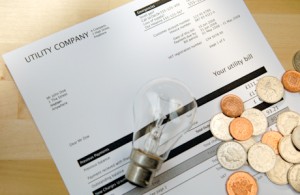
Utility bills for New York City apartments are higher than necessary in (Image: EmpowerNetwork.com)
Or Take Electric Bills — Or Better Yet Don’t
Many New Yorkers (me included) never actually see an electric bill; the cost of powering our apartments is folded into the rent. Our only incentive to buy pricier compact fluorescent (CFL) (or those exciting new LED’s) over cheaper, inefficient incandescent light bulbs, or to eschew space heaters (that devour electricity and cause some 25,000 fires a year), to heat under-heated apartments, is our own eco-conscience — or threat of immolation.
Similarly, many of us also never see a water bill, which means the tremendous amount of energy the City uses to deliver clean water, and to purify waste water also goes unnoticed. In short, New York could use a lot less energy while maintaining its current standard of living.
Add this energy usage to the fuel needs of taxis, and other cars and trucks, and you get a whopping amount of carbon emissions, too. (See Video).
There Are Solutions to New York’s Energy Wastefulness
Buildings create more energy than cars and trucks. The average building, as the good folks over at the White Roof Project like to point out, can slash summer energy use by as much as 40% simply by painting its roof white – a solution that’s not limited to apartment buildings; individual home owners can also follow suit.
Sub-metering and “learning” thermostats like Nest, which keeps tabs on heating and cooling patterns so one uses less energy, while also allowing one to visualize one’s energy usage, are definite steps forward. As are state incentives like NYSERDA’s Residential and Multifamily Performance Programs that provide financial incentives for homeowners and developers who retrofit homes so they use less energy. New York State isn’t the only state with such programs- DSIRE lists incentives by state.
As for me, while I’ve turned down the cockiness knob on how “green” New York is, you’ll have to fight me to the death to give up our regional supremacy when it comes to pizza, bagels and knishes.
Related Posts via Categories




Kendra,
I’m with you on the issues associated with waste being generated when people don’t pay their electric, heating, or water bills on their own. I’ve got another beef: those of us who live alone in our co-op apartments pay the same maintenance as couples — but they take twice as many showers. So I wish the maintenance formula could be altered so that in addition to square footage, occupancy rates could be factored in as well.
Very interesting read Kendra. When I first moved to the US I was surprised that tenants did not see a water or gas bill (in the UK the tenant also pays for Council Tax, but in Australia I believe it is just gas, electricity and excess water). In my case I do see an electricity bill and I agree that being able to see the bill does influence your usage.
Many small businesses could also benefit from a bit of education about how they can operate more efficiently… Last year I started to volunteer with an organisation called Envirolution who train people (from all walks of life and stages of their career that want to transition into a green job) in how to outreach to small businesses and do lighting surveys. I decided to do the practical training and found that a number of small businesses were very wary at first of people trying to tell them that they could save money on their electricity just by upgrading their lights. In a number of these cases it was great to see the transformation once a business could see potential savings, cost of upgrade and payback period (which was significantly shorter due to the incentives on offer). The best experience was when a business then asked what else they could do to save money (and help the environment of course).
As an aside, I suspect that you (and others) may be interested in the Water, food and energy nexus debates – live broadcast on Wednesday February 6, 2013 (http://www.guardian.co.uk/sustainable-business/water-food-energy-nexus-debates-live).
I totally agree. If New York could manage to be more “eco”, it would be great example to all the big cites. Imagine if city as colourful and lively as this one could be an example of a sustainable energy and eco friendly values.
Actually I read an interesting article about how sustainable energy can reduce the bills and help us to live more efficiently. I know that’s already known issue, but I thought this article came up with some nice new ideas. You can find it here if you are interested.
You know, it’s not even that hard to be open to the idea. It’s just some people don’t want to be bothered. And that’s exactly what bothers me.
Jacquie, it would be even better if buildings tracked occupant usage in general. I mean solo living bath loving water hogs who like to leave their high wattage light bulbs on all of the time probably use as much or more energy than less double occupancy frugal couple. For example I use significantly less resources than my similar solo living friend who breeds snakes, has a salt water aquarium and keeps the heat on for his two cats when he’s not home. Each year your percentage of maintenance could be adjusted to your actual usage (and advances in tech make it easier to track usage), incentivizing green behavior AND incentivizing co-ops to go green in general.
Sarah, yep it is interesting how divorced a lot of us are from our resource consumption – it’s not just things like hidden utility bills; think about trash. With regular trash pick up most of us rarely have to think about how much trash we’re generating.
Absolutely agree with you there Kendra! How interesting it would be to see how quickly behaviour would change if the pay per weight/volume of waste was implemented…
Kendra,
Very informational and insightful article, and the animation above was slightly alarming. Of course, I took into consideration that there is a carbon cycle and not all the emissions sit atop our city like a pile of giant balloons; trees take up the CO2 and emit oxygen… and then I got to thinking: New York needs more foliage! I think this would be a great project for a green initiatives company to take on. Where is the money in that and where do we put these, I know, but an interesting idea to ponder none the less.
On another note, it’s amazing how much energy buildings can save by simply painting their roof a light-reflective color. There are a hundred things you can do as an individual to cut down on your energy usage and waste consumption, but it will take a little longer for the big buildings and businesses to come around to the green idea. Businesses can be green and profitable, but it might take a little push from the policy makers to get them going in the right direction.
Thanks for the post!
Kendra,
Nice post! I am not a native New Yorker, but I also take pride in New York’s low level of energy consumption, per capita: http://1.usa.gov/11fOeiV.
An interest in energy issues, and the promise of energy efficiency in the Big Apple led me to my current place of work, called ThinkEco. This Manhattan-based, green start-up partners with Con Edison every summer to eliminate wasted energy use from NYC’s 6 MILLION window ACs!! The program – coolNYC – has been a huge success, however, one significant barrier that exists, is exactly what you mentioned in your post. Participants from “master-meter” buildings don’t engage with the program as much those participants that see an electric bill every month.
I agree with Sarah, it would be interesting and exciting to see how quickly behaviour would change if New Yorkers were in charge of their individual energy use. I know the change would be positive because of the enthusiasm I’ve witnessed when participants receive our smartAC modlet from Con Edison. Who wouldn’t want to save some energy and money?
Hi Kendra,
I too have a love affair with my hometown NYC.
But like any great love, I too can see the flaws in our relationship. Firstly, while most New Yorkers have the option to use mass transit, many opt not to because while our system is good, it’s not great. Efficiency improvements in the subway and bus system might inspire less incentive to stick out your hand and hail down that cab. Traveling from east side to west is unpredictable because there is no indication of when the bus will be arriving. If NY could implement the same timetable schedule that is being placed in some subway lines (4,5, and 6 for sure), then it could inspire more users. I’d much rather know the bus will be here in 10 minutes and wait with a definite expectation, than waiting that same time but not knowing if the bus will ever show up!
Second, yes central heating systems in the buildings are a huge waste of energy. The past summer while working for an environmental company on Church st., I took the subway downtown and walked in the summer heat with a large sweater in my bag because the office was cooled down to a chilly 60 degrees or so. I thought to myself, what a huge waste of energy! I inquired to my boss, but to both our dismays, there was nothing to be done because the building controlled the heat. Many New Yorkers experience the same phenomena. Packing a coat in the summer time for the office, and wearing a T-shirt in the winter because the heat is cranked up. Imagine all the energy that would be saved if a window was opened instead or the thermostat was always set to a comfortable 72 degrees. It’s great to hear about these self-regulating thermostats, but part of the issue is recognizing where a happy medium on temperature is. It’s okay to be slightly warm or slightly cold.
One interesting idea could be to copy the good folks on Tidy Street in Brighton, UK. Jon Bird and Yvonne Rogers decided to set up a low cost energy monitoring system. They monitored household consumption, as well as the street’s average consumption and created an art display on the street to show these monitored numbers. It created a lot of awareness in the area and inspired a change in energy consumption patterns. Awareness, I think, is a large part of the problem. It’s so great that both this post and the commenters on it aim to educate businesses and residents about how (much) they use their energy.
*Info on the Tidy St project: http://www.changeproject.info/publications/energyAwarenessWorkshopBirdRogers.pdf
Coming from the suburbs but spending a lot of time in New York I found this article interesting. I was unaware how little renters know about their water and energy consumption as city-dwellers. This was surprising because outside of the city you’re required to pay for everything separately. While it’s disappointing how much energy is wasted in New York City I found it promising at the same time. As a large city, with people so close together, it’s possible to implement large changes effectively. I believe that the White Roof Project is a perfect example of how small changes can have a large impact.
Yet I also believe that there needs to be a stronger green push from a governmental stand point. As it is pointed out, the actual residents have very little say in what happens where they live and work. Therefore I believe that until there are stronger incentives or stricter requirements for the owners of buildings these campaigns will not be as effective. Overall, I believe that cities are the future of sustainability because they provide an opportunity for more effective energy usage. With that said, simply recognizing the potential is not enough to make a shift towards greener living. Legislative guidelines and tax incentives should also be explored and implemented.
New York actually has been making a significant push on getting things like submetering (so people actually get a heating bill), the question is that much of these changes have to be legislated slowly as they enact a large cost, or incentives which means giving away money. NYSERDA has been doing some great work around creating incentives for retrofits and new constructions, but the problem is the average person’s knowledge/or interest in these issues isn’t there yet. I live in an incredibly well maintained building with a landlord who does a (almost too good since I like it hot) job of not overheating my apartment. However, I’m at work for most of the day my apartment is heated to 65. A smart thermostat (like a nest) would allow me to turn down the temperature to 50 when I’m not home and raise it to 70 my preferred temp when I am home (well my preferred temp is like 95 degrees but I’m too eco for that) for what would likely be less total energy usage since I’m not home so much more than I am home (why do I pay rent again)? ;).
Hi Kendra,
What a great read, I can definitely sympathize with the problem of not having access to a central thermostat for temperature control–I lived in a college apartment in which the thermostat was located in the apartment below mine and the temperature was locked on whatever the residents below me had set it to….they liked to keep the place at a balmy 80 degrees. But luckily, me and my roommates were rather friendly and able to persuade our downstairs neighbors to be mindful of the heat, especially since it rises.
Outside of a college dorm environment, however, I imagine this problem could be the source of many neighborly tensions and needless energy waste if the controller of the thermostat is not willing to change their ways. A major issue that I have recently been confronted with over the summer is the massive energy expenditures of appliances like air conditioning units. If you are interested in learning a little more about energy policies and labeling and standards for appliances I encourage you to check out CLASP–www.clasponline.org–they’re a DC based non-profit that helps educate cities all over the world on energy efficiency best practices. One of their recent initiatives is to increase the awareness of policy makers and manufacturers alike on the energy efficiency of air conditioning units.
In New York City, individual air conditioning units factor a huge cost on the cities environmental footprint, partially from the large amounts of electricity they draw on and also from the polluting coolants they contain. By educating policy makers about the potential environmental impact of ACs, and the benefits that can be reaped from enforcing high energy efficiency standards real change can be made. Once there is an expectation for the highest performing technologies, manufacturers will respond with innovation and improvements making the shift to more eco-friendly products painless for the consumer.
In my opinion, the first step towards change is education. An informed consumer is a very powerful thing. Keep up the good work!
individual consumption is important and people definitely need to monitor their consumption, but how about holding the architecture accountable? Buildings do consume an immense amount of energy and resources, and retrofitting can help reduce impact and costs. One recent and relatively famous example is the Empire State Building – a project with the aim of reducing GHG emissions and environmental impact. This is an expensive endeavor, but it focuses on 8 critical areas: refurbishing all of the windows (6,514); installing insulation behind all radiators; retrofitting the chiller plant; new building management systems controls; new revenue-grade meters for the entire building; and a web-based tenant energy management system. The lighting has been upgraded to 100 percent LED and the elevators are 30% more efficient and send excess energy to the building’s grid. This retrofit has decreased the building’s energy demand and consumption – approximately a 38% decrease and added a savings of about $4 million each year.
Retrofitting buildings to consume less energy and reusing valuable materials can help create sustainable cities and a knowledgeable and conscious community.
As a college student here in NYC, I encounter many of these issues on campus buildings such as dormitories and libraries rather than in apartments. With students often staying up all night working in libraries or dorm lounges, lights are sometimes left on for days at a time. Students are not conscious of their heating or cooling systems, shower length, etc. due to the flat housing rate per dorm. Various environmental groups on campus have began to address some of these issues, by placing energy savings signs above light switches or signs encouraging you to “burn calories rather than electricity” by the elevator. It would be curious to study potential methods that could be utilized in a university setting to individually address energy efficiency, perhaps by incentivizing sustainable behavior. Further, I wonder what successful programs have been installed in apartments throughout the country that can transition into the university setting?
Similar to electricity bills masked in rent payments, our electricity and water costs are included in our housing fee, a flat rate based on your dorm location. Some of the dorms at my school have not been adequately renovated since their initial construction. I would be interested to see how installing energy efficient appliances in dorm kitchens, light dimmers, and even more efficient heating/cooling systems would influence housing costs. Although environmental organizations are specifically devoted to evaluating how to “green” my school overall, I believe that the housing sector is an area that holds much potential to inspire behavioral change and reduce my college’s footprint.